


Page 164 - Complete Birds of Britain and Europe (DK - RSPB)
P. 164
CRANES AND BUSTARDS
       Order Gruiformes       Family Otitidae        Species Tetrax tetrax
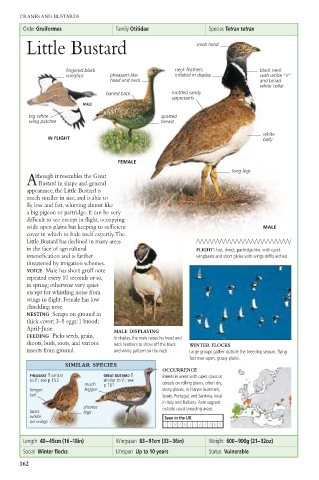
        Little Bustard                            small head


                 fingered black             neck feathers         black neck
                 wingtips   pheasant-like   inflated in display   with white “V”
                            head and neck                         and broad
                                                                  white collar
                           barred back      mottled sandy
                                            upperparts
                      MALE
        big white                        spotted
        wing patches                     breast
                                                                  white
             IN FLIGHT                                            belly


                              FEMALE
                                                           long legs
          lthough it resembles the Great
        A Bustard in shape and general
        appearance, the Little Bustard is
        much smaller in size, and is able to
        fly low and fast, whirring almost like
        a big pigeon or partridge. It can be very
        difficult to see except in flight, occupying
        wide open plains but keeping to sufficient                MALE
        cover in which to hide itself expertly.The
        Little Bustard has declined in many areas
        in the face of agricultural               FLIGHT: fast, direct, partridge-like, with quick
        intensification and is further            wingbeats and short glides with wings stiffly arched.
        threatened by irrigation schemes.
        VOICE Male has short gruff note
        repeated every 10 seconds or so,
        in spring; otherwise very quiet
        except for whistling noise from
        wings in flight. Female has low
        chuckling note.
        NESTING Scrape on ground in
        thick cover; 3–5 eggs; 1 brood;
        April–June.          MALE DISPLAYING
        FEEDING Picks seeds, grain,  In display, the male raises his head and
        shoots, buds, roots, and various  neck feathers to show off the black  WINTER FLOCKS
        insects from ground.  and white pattern on the neck.  Large groups gather outside the breeding season, flying
                                                fast over open, grassy plains.
                 SIMILAR SPECIES
                                         OCCURRENCE
        PHEASANT 2similar  GREAT BUSTARD 2  Breeds in areas with open grass or
        to 2; see p.153    similar to 2; see
                      much  p.161        cereals on rolling plains, often dry,
        longer        bigger             stony places, in France (summer),
        tail                             Spain, Portugal, and Sardinia; local
                                         in Italy and Balkans. Rare vagrant
                      shorter            outside usual breeding areas.
        lacks         legs
        white                             Seen in the UK
        on wings
                                          JF M A  M J  JA S ON D
       Length  40–45cm (16–18in)  Wingspan  83–91cm (33–36in)  Weight  600–900g (21–32oz)
       Social  Winter flocks  Lifespan  Up to 10 years  Status  Vulnerable
      162

