


Page 169 - Complete Birds of Britain and Europe (DK - RSPB)
P. 169
WADERS
       Order Charadriiformes  Family Burhinidae      Species Burhinus oedicnemus
        Stone-curlew

                                                             pale eye  pale bill-
                                                    pale stripes
               light and dark bands     pale face   above and       base
               on pale inner wings      and bill-base  below eye
                   head
                   outstretched
                                      long, dark-
                                      streaked, sandy
                                      brown body
         pale     ADULT
         tail                                                       broad pale
                                                                    band along
                  white spot                                        wings
                  on black
                  outer wings
                            JUVENILE                       long, pale
            IN FLIGHT                                      yellow legs
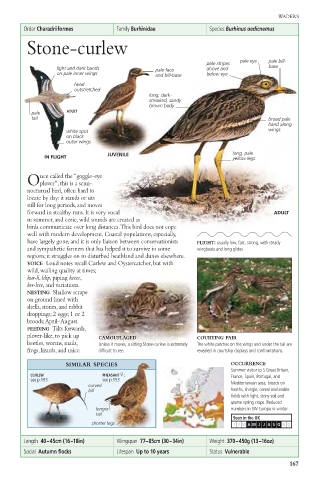
           nce called the “goggle-eye
        Oplover”, this is a semi-
        nocturnal bird, often hard to
        locate by day: it stands or sits
        still for long periods, and moves
        forward in stealthy runs. It is very vocal                   ADULT
        in summer, and eerie, wild sounds are created as
        birds communicate over long distances.This bird does not cope
        well with modern development. Coastal populations, especially,
        have largely gone, and it is only liaison between conservationists  FLIGHT: usually low, fast, strong, with steady
        and sympathetic farmers that has helped it to survive in some  wingbeats and long glides.
        regions; it struggles on in disturbed heathland and dunes elsewhere.
        VOICE Loud notes recall Curlew and Oystercatcher, but with
        wild, wailing quality at times;
        kur-li, klip, piping keeee,
        krr-leee, and variations.
        NESTING Shallow scrape
        on ground lined with
        shells, stones, and rabbit
        droppings; 2 eggs; 1 or 2
        broods;April–August.
        FEEDING Tilts forwards,
        plover-like, to pick up  CAMOUFLAGED      COURTING PAIR
        beetles, worms, snails,  Unless it moves, a sitting Stone-curlew is extremely  The white patches on the wings and under the tail are
        frogs, lizards, and mice.  difficult to see.  revealed in courtship displays and confrontations.
                 SIMILAR SPECIES                          OCCURRENCE
                                                          Summer visitor to S Great Britain,
         CURLEW           PHEASANT 2;                     France, Spain, Portugal, and
         see p.193        see p.153
                       curved                             Mediterranean area; breeds on
                       bill                               heaths, shingle, cereal and arable
                                                          fields with light, stony soil and
                                                          sparse spring crops. Reduced
                         longer                           numbers in SW Europe in winter.
                         tail
                                                           Seen in the UK
                        shorter legs                       J  F  M  A  M  JJ A S O  N  D
       Length  40–45cm (16–18in)  Wingspan  77–85cm (30–34in)  Weight  370–450g (13–16oz)
       Social  Autumn flocks  Lifespan  Up to 10 years  Status  Vulnerable
                                                                         167

