


Page 167 - Complete Birds of Britain and Europe (DK - RSPB)
P. 167
WADERS
       Order Charadriiformes  Family Recurvirostridae  Species Recurvirostra avosetta
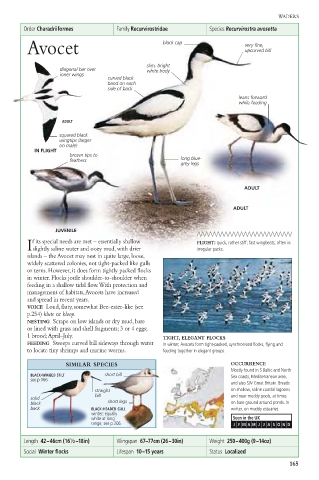
        Avocet                           black cap            very fine,
                                                              upcurved bill
                                     slim, bright
                diagonal bar over    white body
                inner wings
                            curved black
                            band on each
                            side of back
                                                            leans forward
                                                            while feeding
                ADULT

                squared black
                wingtips (larger
                on male)
          IN FLIGHT
                  brown tips to
                  feathers                    long blue-
                                              grey legs
                                                              ADULT

                                                           ADULT

               JUVENILE
         f its special needs are met – essentially shallow  FLIGHT: quick, rather stiff; fast wingbeats; often in
        Islightly saline water and oozy mud, with drier  irregular packs.
        islands – the Avocet may nest in quite large, loose,
        widely scattered colonies, not tight-packed like gulls
        or terns. However, it does form tightly packed flocks
        in winter. Flocks jostle shoulder-to-shoulder when
        feeding in a shallow tidal flow.With protection and
        management of habitats,Avocets have increased
        and spread in recent years.
        VOICE Loud, fluty, somewhat Bee-eater-like (see
        p.254) klute or kloop.
        NESTING Scrape on low islands or dry mud, bare
        or lined with grass and shell fragments; 3 or 4 eggs;
        1 brood;April–July.               TIGHT, ELEGANT FLOCKS
        FEEDING Sweeps curved bill sideways through water  In winter, Avocets form tight-packed, synchronized flocks, flying and
        to locate tiny shrimps and marine worms.  feeding together in elegant groups.
                 SIMILAR SPECIES                          OCCURRENCE
                                                          Mostly found in S Baltic and North
         BLACK-WINGED STILT  short bill                   Sea coasts, Mediterranean area,
         see p.166
                                                          and also SW Great Britain. Breeds
                         straight                         on shallow, saline coastal lagoons
                         bill                             and near muddy pools, at times
         solid
         black              short legs                    on bare ground around ponds. In
         back           BLACK-HEADED GULL                 winter, on muddy estuaries.
                        winter; equally
                        white at long                      Seen in the UK
                        range; see p.206                   J  F  M  A  M  JJ A S O  N  D
       Length  42–46cm (16 1 ⁄2 –18in)  Wingspan  67–77cm (26–30in)  Weight  250–400g (9–14oz)
       Social  Winter flocks  Lifespan  10–15 years  Status  Localized
                                                                         165

