


Page 174 - Complete Birds of Britain and Europe (DK - RSPB)
P. 174
WADERS
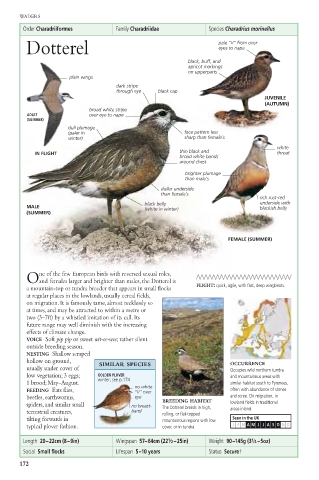
       Order Charadriiformes  Family Charadriidae    Species Charadrius morinellus
        Dotterel                                       pale “V” from over
                                                       eyes to nape
                                                black, buff, and
                                                apricot markings
                                                on upperparts
                  plain wings
                              dark stripe
                              through eye  black cap
                                                                   JUVENILE
                                                                   (AUTUMN)
                       broad white stripe
        ADULT          over eye to nape
        (SUMMER)
                  dull plumage
                  (paler in                    face pattern less
                  winter)                      sharp than female’s
                                                                      white
                                              thin black and
          IN FLIGHT                                                   throat
                                              broad white bands
                                              around chest
                                               brighter plumage
                                               than male’s
                                         duller underside
                                         than female’s
                                                                  rich rust-red
                                     black belly                  underside with
        MALE                         (white in winter)            blackish belly
        (SUMMER)
                                                          FEMALE (SUMMER)


           ne of the few European birds with reversed sexual roles,
        Oand females larger and brighter than males, the Dotterel is
        a mountain-top or tundra breeder that appears in small flocks   FLIGHT: quick, agile, with fast, deep wingbeats.
        at regular places in the lowlands, usually cereal fields,
        on migration. It is famously tame, almost recklessly so
        at times, and may be attracted to within a metre or
        two (3–7ft) by a whistled imitation of its call. Its
        future range may well diminish with the increasing
        effects of climate change.
        VOICE Soft pip pip or sweet wit-ee-wee; rather silent
        outside breeding season.
        NESTING Shallow scraped
        hollow on ground,  SIMILAR SPECIES                OCCURRENCE
        usually under cover of                            Occupies wild northern tundra
        low vegetation; 3 eggs;  GOLDEN PLOVER            and mountainous areas with
        1 brood; May–August.  winter; see p.174           similar habitat south to Pyrenees,
        FEEDING Eats flies,       no white                often with abundance of stones
                                  “V” over
        beetles, earthworms,      eye                     and scree. On migration, in
        spiders, and similar small  no breast-  BREEDING HABITAT  lowland fields in traditional
                                         The Dotterel breeds in high,
        terrestrial creatures,    band   rolling, or flat-topped  areas inland.
        tilting forwards in              mountainous regions with low  Seen in the UK
        typical plover fashion.          cover, or in tundra.  J  F  M  A  M  JJ A S O  N  D
       Length  20–22cm (8–9in)  Wingspan  57–64cm (22 1 ⁄2 –25in)  Weight  90–145g (3 1 ⁄4 –5oz)
       Social  Small flocks   Lifespan  5–10 years   Status  Secure†
      172

