


Page 173 - Complete Birds of Britain and Europe (DK - RSPB)
P. 173
WADERS
       Order Charadriiformes  Family Charadriidae    Species Charadrius alexandrinus
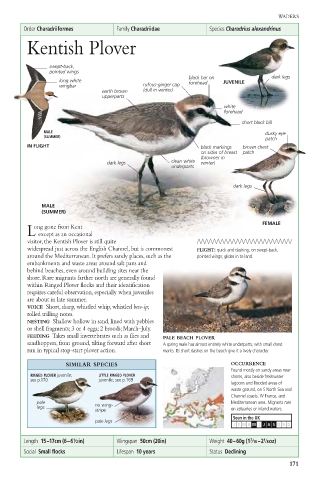
        Kentish Plover


             swept-back,
             pointed wings
                                                black bar on        dark legs
                long white                      forehead  JUVENILE
                wingbar              rufous-ginger cap
                          earth brown  (dull in winter)
                          upperparts
                                                         white
                                                         forehead
                                                             short black bill
            MALE                                                   dusky eye
            (SUMMER)
                                                                   patch
        IN FLIGHT                                  black markings  brown chest
                                                   on sides of breast  patch
                                                   (browner in
                            dark legs       clean white  winter)
                                            underparts
                                                           dark legs


           MALE
           (SUMMER)
                                                                  FEMALE
         ong gone from Kent
        L except as an occasional
        visitor, the Kentish Plover is still quite
        widespread just across the English Channel, but is commonest  FLIGHT: quick and dashing, on swept-back,
        around the Mediterranean. It prefers sandy places, such as the  pointed wings; glides in to land.
        embankments and waste areas around salt pans and
        behind beaches, even around building sites near the
        shore. Rare migrants farther north are generally found
        within Ringed Plover flocks and their identification
        requires careful observation, especially when juveniles
        are about in late summer.
        VOICE Short, sharp, whistled whip, whistled bew-ip;
        rolled trilling notes.
        NESTING Shallow hollow in sand, lined with pebbles
        or shell fragments; 3 or 4 eggs; 2 broods; March–July.
        FEEDING Takes small invertebrates such as flies and  PALE BEACH PLOVER
        sandhoppers, from ground, tilting forward after short  A spring male has almost entirely white underparts, with small chest
        run in typical stop-start plover action.  marks. Its short dashes on the beach give it a lively character.
                 SIMILAR SPECIES                          OCCURRENCE
                                                          Found mostly on sandy areas near
         RINGED PLOVER juvenile;  LITTLE RINGED PLOVER    shores, also beside freshwater
         see p.170        juvenile; see p.169
                                                          lagoons and flooded areas of
                                                          waste ground, on S North Sea and
                                                          Channel coasts, W France, and
          pale                                            Mediterranean area. Migrants rare
          legs           no wing-                         on estuaries or inland waters.
                         stripe
                                                           Seen in the UK
                         pale legs
                                                           JF M A  M J  JA S ON D
       Length  15–17cm (6–6 1 ⁄2in)  Wingspan  50cm (20in)  Weight  40–60g (1 7 ⁄16 –2 1 ⁄8oz)
       Social  Small flocks   Lifespan  10 years     Status  Declining
                                                                         171

