


Page 177 - Complete Birds of Britain and Europe (DK - RSPB)
P. 177
WADERS
       Order Charadriiformes  Family Charadriidae    Species Vanellus vanellus
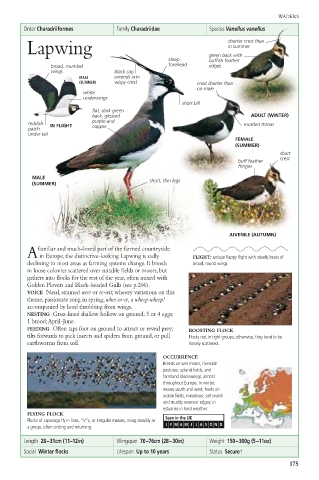
        Lapwing                                           shorter crest than
                                                          in summer
                                                     green back with
                                           steep     buffish feather
              broad, rounded               forehead  edges
              wings          black cap
                     MALE    extends into
                     (SUMMER)  wispy crest        crest shorter than
                                                  on male
                      white
                      underwings
                                              short bill
                        flat, dark green
                        back, glossed                          ADULT (WINTER)
                        purple and
        reddish  IN FLIGHT  copper                            mottled throat
        patch
        under tail
                                                           FEMALE
                                                           (SUMMER)
                                                                       short
                                                                       crest
                                                            buff feather
                                                            fringes
         MALE                         short, thin legs
         (SUMMER)


                                                          JUVENILE (AUTUMN)
          familiar and much-loved part of the farmed countryside
        A in Europe, the distinctive-looking Lapwing is sadly   FLIGHT: unique flappy flight with steady beats of
        declining in most areas as farming systems change. It breeds   broad, round wings.
        in loose colonies scattered over suitable fields or moors, but
        gathers into flocks for the rest of the year, often mixed with
        Golden Plovers and Black-headed Gulls (see p.206).
        VOICE Nasal, strained weet or ee-wit; wheezy variations on this
        theme; passionate song in spring, whee-er-ee, a wheep-wheep!
        accompanied by loud throbbing from wings.
        NESTING Grass-lined shallow hollow on ground; 3 or 4 eggs;
        1 brood;April–June.
        FEEDING Often taps foot on ground to attract or reveal prey;  ROOSTING FLOCK
        tilts forwards to pick insects and spiders from ground, or pull  Flocks rest in tight groups; otherwise, they tend to be
        earthworms from soil.                   loosely scattered.
                                          OCCURRENCE
                                          Breeds on wet moors, riverside
                                          pastures, upland fields, and
                                          farmland (decreasing), almost
                                          throughout Europe. In winter,
                                          moves south and west, feeds on
                                          arable fields, meadows, salt marsh
                                          and muddy reservoir edges; in
                                          estuaries in hard weather.
        FLYING FLOCK
                                          Seen in the UK
        Flocks of Lapwings fly in lines, “V”s, or irregular masses, rising steadily as
                                          J  F  M  A  M  JJ A S O  N  D
        a group, often circling and returning.
       Length  28–31cm (11–12in)  Wingspan  70–76cm (28–30in)  Weight  150–300g (5–11oz)
       Social  Winter flocks  Lifespan  Up to 10 years  Status  Secure†
                                                                         175

