


Page 175 - Complete Birds of Britain and Europe (DK - RSPB)
P. 175
WADERS
       Order Charadriiformes  Family Charadriidae    Species Pluvialis squatarola
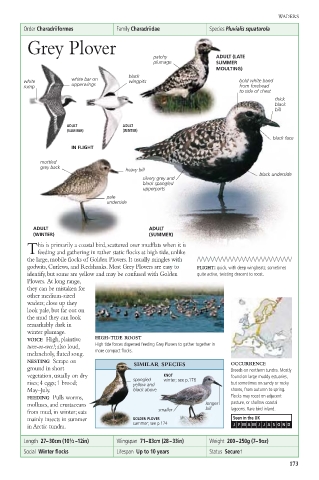
        Grey Plover
                                       patchy          ADULT (LATE
                                       plumage         SUMMER
                                                       MOULTING)
                                 black
       white       white bar on  wingpits                   bold white band
       rump        upperwings                               from forehead
                                                            to side of chest
                                                                     thick
                                                                     black
                                                                     bill
                  ADULT         ADULT
                  (SUMMER)      (WINTER)
                                                                     black face
                   IN FLIGHT

           mottled
           grey back
                                heavy bill
                                                                 black underside
                                    silvery grey and
                                    black spangled
                                    upperparts
                            pale
                            underside
         ADULT                        ADULT
         (WINTER)                     (SUMMER)
          his is primarily a coastal bird, scattered over mudflats when it is
        Tfeeding and gathering in rather static flocks at high tide, unlike
        the large, mobile flocks of Golden Plovers. It usually mingles with
        godwits, Curlews, and Redshanks. Most Grey Plovers are easy to  FLIGHT: quick, with deep wingbeats; sometimes
        identify, but some are yellow and may be confused with Golden  quite active, twisting descent to roost.
        Plovers. At long range,
        they can be mistaken for
        other medium-sized
        waders; close up they
        look pale, but far out on
        the mud they can look
        remarkably dark in
        winter plumage.
        VOICE High, plaintive  HIGH-TIDE ROOST
        twee-oo-wee!; also loud,  High tide forces dispersed feeding Grey Plovers to gather together in
        melancholy, fluted song.  more compact flocks.
        NESTING Scrape on         SIMILAR SPECIES         OCCURRENCE
        ground in short                                   Breeds on northern tundra. Mostly
        vegetation, usually on dry        KNOT            found on large muddy estuaries,
        rises; 4 eggs; 1 brood;   spangled  winter; see p.176  but sometimes on sandy or rocky
                                  yellow and
        May–July.                 black above             shores, from autumn to spring.
        FEEDING Pulls worms,                              Flocks may roost on adjacent
        molluscs, and crustaceans                   longer  pasture, or shallow coastal
        from mud, in winter; eats       smaller     bill  lagoons. Rare bird inland.
        mainly insects in summer  GOLDEN PLOVER            Seen in the UK
        in Arctic tundra.         summer; see p.174        J  F  M  A  M  JJ A S O  N  D
       Length  27–30cm (10 1 ⁄2 –12in)  Wingspan  71–83cm (28–33in)  Weight  200–250g (7–9oz)
       Social  Winter flocks  Lifespan  Up to 10 years  Status  Secure†
                                                                         173

