


Page 209 - Complete Birds of Britain and Europe (DK - RSPB)
P. 209
SKUAS, GULLS,AND TERNS
       Order Charadriiformes  Family Laridae         Species Larus canus
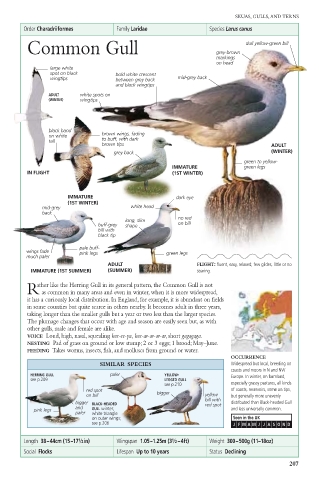
        Common Gull                                    grey-brown  dull yellow-green bill

                                                       markings
                                                       on head
             large white
             spot on black    bold white crescent
             wingtips         between grey back  mid-grey back
                              and black wingtips
             ADULT   white spots on
             (WINTER)  wingtips


             black band
             on white     brown wings, fading
             tail         to buff, with dark
                          brown tips                                ADULT
                             grey back                              (WINTER)
                                                              green to yellow-
                                            IMMATURE          green legs
        IN FLIGHT                           (1ST WINTER)

                  IMMATURE                   dark eye
                  (1ST WINTER)
           mid-grey              white head
           back
                                             no red
                                long, slim
                         buff-grey  shape    on bill
                         bill with
                         black tip
                     pale buff-
        wings fade   pink legs            green legs
        much paler
                            ADULT                 FLIGHT: fluent, easy, relaxed; few glides; little or no
         IMMATURE (1ST SUMMER)  (SUMMER)          soaring.
          ather like the Herring Gull in its general pattern, the Common Gull is not
        R as common in many areas and even in winter, when it is more widespread,
        it has a curiously local distribution. In England, for example, it is abundant on fields
        in some counties but quite scarce in others nearby. It becomes adult in three years,
        taking longer than the smaller gulls but a year or two less than the larger species.
        The plumage changes that occur with age and season are easily seen but, as with
        other gulls, male and female are alike.
        VOICE Loud, high, nasal, squealing kee-ee-ya, kee-ar-ar-ar-ar, short gagagaga.
        NESTING Pad of grass on ground or low stump; 2 or 3 eggs; 1 brood; May–June.
        FEEDING Takes worms, insects, fish, and molluscs from ground or water.
                                                          OCCURRENCE
                          SIMILAR SPECIES                 Widespread but local, breeding on
                                                          coasts and moors in N and NW
         HERRING GULL       paler         YELLOW-         Europe. In winter, on farmland,
         see p.209                        LEGGED GULL
                                          see p.210       especially grassy pastures, all kinds
                      red spot                            of coasts, reservoirs, some on tips,
                      on bill           bigger      yellow  but generally more unevenly
                                                    bill with
                    bigger  BLACK-HEADED            red spot  distributed than Black-headed Gull
                    and  GULL winter;                     and less universally common.
         pink legs
                    paler  white triangle
                        on outer wings;                    Seen in the UK
                        see p.206                          J  F  M  A  M  JJ A S O  N  D
       Length  38–44cm (15–17 1 ⁄2in)  Wingspan  1.05–1.25m (3 1 ⁄2 –4ft)  Weight  300–500g (11–18oz)
       Social  Flocks         Lifespan  Up to 10 years  Status  Declining
                                                                         207

