


Page 213 - Complete Birds of Britain and Europe (DK - RSPB)
P. 213
SKUAS, GULLS,AND TERNS
       Order Charadriiformes  Family Laridae         Species Larus fuscus
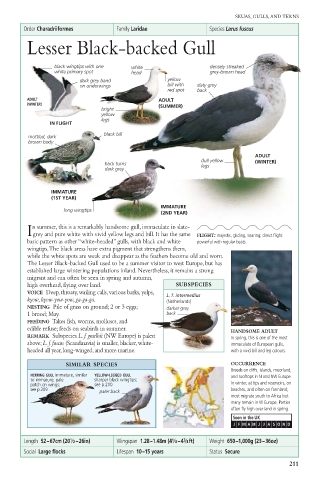
        Lesser Black-backed Gull


               black wingtips with one  white        densely streaked
               white primary spot  head              grey-brown head
                     dark grey band        yellow
                     on underwings         bill with  slaty grey
                                           red spot  back
        ADULT                           ADULT
        (WINTER)                        (SUMMER)
                          bright
                          yellow
                          legs
             IN FLIGHT
                           black bill
        mottled, dark
        brown body
                                                                ADULT
                                                   dull yellow
                           back turns              legs         (WINTER)
                           dark grey
              IMMATURE
              (1ST YEAR)
                                         IMMATURE
                 long wingtips
                                         (2ND YEAR)
         n summer, this is a remarkably handsome gull, immaculate in slate-
        Igrey and pure white with vivid yellow legs and bill. It has the same  FLIGHT: majestic, gliding, soaring; direct flight
        basic pattern as other “white-headed” gulls, with black and white  powerful with regular beats.
        wingtips.The black areas have extra pigment that strengthens them,
        while the white spots are weak and disappear as the feathers become old and worn.
        The Lesser Black-backed Gull used to be a summer visitor to west Europe, but has
        established large wintering populations inland. Nevertheless, it remains a strong
        migrant and can often be seen in spring and autumn,
        high overhead, flying over land.     SUBSPECIES
        VOICE Deep,throaty,wailing calls,various barks,yelps,  L. f. intermedius
        kyow, kyow-yow-yow, ga-ga-ga.     (Netherlands)
        NESTING Pile of grass on ground; 2 or 3 eggs;  darker grey
        1 brood; May.                     back
        FEEDING Takes fish, worms, molluscs, and
        edible refuse; feeds on seabirds in summer.       HANDSOME ADULT
        REMARK Subspecies L.f.graellsii (NW Europe) is palest  In spring, this is one of the most
        above;L.f.fuscus (Scandinavia) is smaller,blacker,white-  immaculate of European gulls,
        headed all year,long-winged,and more marine.      with a vivid bill and leg colours.
                 SIMILAR SPECIES                          OCCURRENCE
                                                          Breeds on cliffs, islands, moorland,
         HERRING GULL immature, similar  YELLOW-LEGGED GULL  and rooftops in N and NW Europe.
         to immature; pale   sharper black wingtips;
         patch on wings;   see p.210                      In winter, at tips and reservoirs, on
         see p.209        paler back                      beaches, and often on farmland;
                                                          most migrate south to Africa but
                                                          many remain in W Europe. Parties
                                                          often fly high over land in spring.
                                                           Seen in the UK
                                                           J  F  M  A  M  JJ A S O  N  D
       Length  52–67cm (20 1 ⁄2 –26in)  Wingspan  1.28–1.48m (4 1 ⁄4 –4 3 ⁄4ft)  Weight  650–1,000g (23–36oz)
       Social  Large flocks   Lifespan  10–15 years  Status  Secure
                                                                         211

