


Page 212 - Complete Birds of Britain and Europe (DK - RSPB)
P. 212
SKUAS, GULLS,AND TERNS
       Order Charadriiformes  Family Laridae         Species Larus (cachinnans) michahellis
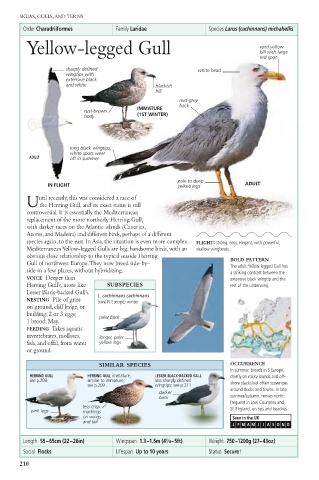
        Yellow-legged Gull                                        vivid yellow
                                                                  bill with large
                                                                  red spot
                 sharply defined                  white head
                 wingtips with
                 extensive black
                 and white              blackish
                                        bill
                                              mid-grey
                                              back
                                   IMMATURE
                      rust-brown
                      body         (1ST WINTER)


                  long black wingtips,
                  white spots wear
        ADULT     off in summer

                                             pale to deep
             IN FLIGHT                       yellow legs      ADULT
           ntil recently, this was considered a race of
        Uthe Herring Gull, and its exact status is still
        controversial. It is essentially the Mediterranean
        replacement of the more northerly Herring Gull,
        with darker races on the Atlantic islands (Canaries,
        Azores, and Madeira) and different birds, perhaps of a different
        species again, to the east. In Asia, the situation is even more complex.  FLIGHT: strong, easy, elegant, with powerful,
        Mediterranean Yellow-legged Gulls are big, handsome birds, with an  shallow wingbeats.
        obvious close relationship to the typical seaside Herring  BOLD PATTERN
        Gull of northwest Europe.They now breed side-by-  The adult Yellow-legged Gull has
        side in a few places, without hybridizing.        a striking contrast between the
        VOICE Deeper than                                 extensive black wingtip and the
        Herring Gull’s, more like  SUBSPECIES             rest of the underwing.
        Lesser Black-backed Gull’s.  L. cachinnans cachinnans
        NESTING Pile of grass   (rare N Europe) winter
        on ground, cliff ledge, or
        building; 2 or 3 eggs;  paler back
        1 brood; May.
        FEEDING Takes aquatic
        invertebrates, molluscs,  longer, paler
        fish, and offal, from water  yellow legs
        or ground.
                          SIMILAR SPECIES                 OCCURRENCE
                                                          In summer, breeds in S Europe,
        HERRING GULL   HERRING GULL immature,  LESSER BLACK-BACKED GULL  chiefly on rocky islands and off-
        see p.209      similar to immature;   less sharply defined  shore stacks but often scavenges
                       see p.209        wingtips; see p.211
                                                          around docks and towns. In late
                                         darker
                                         back             summer/autumn, moves north;
                                                          frequent in Low Countries and
                      less crisp                          SE England, on tips and beaches.
         pink legs    markings
                      on wings                             Seen in the UK
                      and tail
                                                           J  F  M  A  M  JJ A S O  N  D
       Length  55–65cm (22–26in)  Wingspan  1.3–1.5m (4 1 ⁄4–5ft)  Weight  750–1200g (27–43oz)
       Social  Flocks         Lifespan  Up to 10 years  Status  Secure†
      210

