


Page 240 - Complete Birds of Britain and Europe (DK - RSPB)
P. 240
OWLS/NIGHTJARS
        Families Strigidae, Tytonidae
        OWLS

           WLS ARE highly
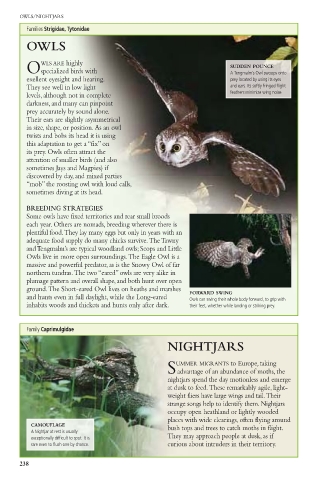
                                                          SUDDEN POUNCE
        Ospecialized birds with                           A Tengmalm’s Owl swoops onto
        exellent eyesight and hearing.                    prey located by using its eyes
        They see well in low light                        and ears. Its softly fringed flight
                                                          feathers minimize wing noise.
        levels, although not in complete
        darkness, and many can pinpoint
        prey accurately by sound alone.
        Their ears are slightly asymmetrical
        in size, shape, or position. As an owl
        twists and bobs its head it is using
        this adaptation to get a “fix” on
        its prey. Owls often attract the
        attention of smaller birds (and also
        sometimes Jays and Magpies) if
        discovered by day, and mixed parties
        “mob” the roosting owl with loud calls,
        sometimes diving at its head.

        BREEDING STRATEGIES
        Some owls have fixed territories and rear small broods
        each year. Others are nomads, breeding wherever there is
        plentiful food.They lay many eggs but only in years with an
        adequate food supply do many chicks survive.The Tawny
        and Tengmalm’s are typical woodland owls; Scops and Little
        Owls live in more open surroundings.The Eagle Owl is a
        massive and powerful predator, as is the Snowy Owl of far
        northern tundras.The two “eared” owls are very alike in
        plumage pattern and overall shape,and both hunt over open
        ground.The Short-eared Owl lives on heaths and marshes
                                                FORWARD SWING
        and hunts even in full daylight, while the Long-eared  Owls can swing their whole body forward, to grip with
        inhabits woods and thickets and hunts only after dark.  their feet, whether while landing or striking prey.


        Family Caprimulgidae
                                           NIGHTJARS

                                             UMMER MIGRANTS to Europe, taking
                                           S advantage of an abundance of moths, the
                                           nightjars spend the day motionless and emerge
                                           at dusk to feed.These remarkably agile, light-
                                           weight fliers have large wings and tail.Their
                                           strange songs help to identify them.Nightjars
                                           occupy open heathland or lightly wooded
                                           places with wide clearings, often flying around
         CAMOUFLAGE                        bush tops and trees to catch moths in flight.
         A Nightjar at rest is usually
         exceptionally difficult to spot. It is  They may approach people at dusk, as if
         rare even to flush one by chance.  curious about intruders in their territory.

      238

