


Page 241 - Complete Birds of Britain and Europe (DK - RSPB)
P. 241
OWLS
       Order Strigiformes     Family Strigidae       Species Strix aluco
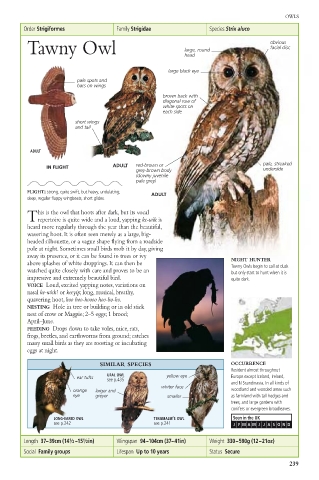
        Tawny Owl                              large, round         obvious
                                                                    facial disc
                                               head

                                           large black eye
                    pale spots and
                    bars on wings
                                         brown back with
                                         diagonal row of
                                         white spots on
                                         each side
                    short wings
                    and tail

         ADULT

             IN FLIGHT       ADULT  red-brown or                  pale, streaked
                                                                  underside
                                   grey-brown body
                                   (downy juvenile
                                   pale grey)
        FLIGHT: strong, quite swift, but heavy, undulating;  ADULT
        deep, regular flappy wingbeats, short glides.
          his is the owl that hoots after dark, but its vocal
        Trepertoire is quite wide and a loud, yapping ke-wik is
        heard more regularly through the year than the beautiful,
        wavering hoot. It is often seen merely as a large, big-
        headed silhouette, or a vague shape flying from a roadside
        pole at night. Sometimes small birds mob it by day, giving
        away its presence, or it can be found in trees or ivy
        above splashes of white droppings. It can then be  NIGHT HUNTER
                                                          Tawny Owls begin to call at dusk
        watched quite closely with care and proves to be an  but only start to hunt when it is
        impressive and extremely beautiful bird.          quite dark.
        VOICE Loud, excited yapping notes, variations on
        nasal ke-wick! or keeyip; long, musical, breathy,
        quavering hoot, hoo hoo-hoooo hoo-ho-ho.
        NESTING Hole in tree or building or in old stick
        nest of crow or Magpie; 2–5 eggs; 1 brood;
        April–June.
        FEEDING Drops down to take voles, mice, rats,
        frogs, beetles, and earthworms from ground; catches
        many small birds as they are roosting or incubating
        eggs at night.
                          SIMILAR SPECIES                 OCCURRENCE
                                                          Resident almost throughout
                            URAL OWL
                    ear tufts  see p.435  yellow eye      Europe except Iceland, Ireland,
                                                          and N Scandinavia. In all kinds of
                                         whiter face
                   orange  larger and                     woodland and wooded areas such
                   eye   greyer            smaller        as farmland with tall hedges and
                                                          trees, and large gardens with
                                                          conifers or evergreen broadleaves.
              LONG-EARED OWL           TENGMALM’S OWL      Seen in the UK
              see p.242                see p.241           J  F  M  A  M  JJ A S O  N  D
       Length  37–39cm (14 1 ⁄2 –15 1 ⁄2in)  Wingspan  94–104cm (37–41in)  Weight  330–590g (12–21oz)
       Social  Family groups  Lifespan  Up to 10 years  Status  Secure
                                                                         239

