


Page 242 - Complete Birds of Britain and Europe (DK - RSPB)
P. 242
OWLS
       Order Strigiformes     Family Strigidae       Species Bubo bubo
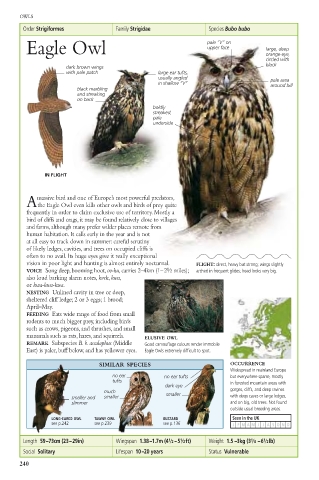
        Eagle Owl                                   pale “V” on    large, deep
                                                    upper face
                                                                   orange eye,
                                                                   circled with
                                                                   black
                 dark brown wings
                 with pale patch        large ear tufts,
                                        usually angled              pale area
                                        in shallow “V”              around bill
                    black marbling
                    and streaking
                    on back
                                       boldly
                                       streaked,
                                       pale
                                       underside


            IN FLIGHT

          massive bird and one of Europe’s most powerful predators,
        Athe Eagle Owl even kills other owls and birds of prey quite
        frequently in order to claim exclusive use of territory. Mostly a
        bird of cliffs and crags, it may be found relatively close to villages
        and farms,although many prefer wilder places remote from
        human habitation. It calls early in the year and is not
        at all easy to track down in summer: careful scrutiny
        of likely ledges, cavities, and trees on occupied cliffs is
        often to no avail. Its huge eyes give it really exceptional
        vision in poor light and hunting is almost entirely nocturnal.  FLIGHT: direct, heavy but strong; wings slightly
        VOICE Song deep,booming hoot,oo-hu,carries 2–4km (1–2 ⁄2 miles);  arched in frequent glides; head looks very big.
                                          1
        also loud barking alarm notes, kvek, kwa,
        or kwa-kwa-kwa.
        NESTING Unlined cavity in tree or deep,
        sheltered cliff ledge; 2 or 3 eggs; 1 brood;
        April–May.
        FEEDING Eats wide range of food from small
        rodents to much bigger prey, including birds
        such as crows, pigeons, and thrushes, and small
        mammals such as rats, hares, and squirrels.  ELUSIVE OWL
        REMARK Subspecies B. b. ascalaphus (Middle  Good camouflage colours render immobile
        East) is paler, buff below, and has yellower eyes.  Eagle Owls extremely difficult to spot.
                          SIMILAR SPECIES                 OCCURRENCE
                                                          Widespread in mainland Europe
                             no ear       no ear tufts    but everywhere sparse, mostly
                             tufts                        in forested mountain areas with
                                          dark eye
                           much           smaller         gorges, cliffs, and deep ravines
                   smaller and  smaller                   with deep caves or large ledges,
                   slimmer                                and on big, old trees. Not found
                                                          outside usual breeding areas.
              LONG-EARED OWL  TAWNY OWL   BUZZARD          Seen in the UK
              see p.242  see p.239        see p.136        JF M A  M J  JA S ON D
       Length  59–73cm (23–29in)  Wingspan  1.38–1.7m (4 1 ⁄2 –5 1 ⁄2ft)  Weight  1.5 –3kg (3 1 ⁄4 –6 1 ⁄2lb)
       Social  Solitary       Lifespan  10–20 years  Status  Vulnerable
      240

