


Page 243 - Complete Birds of Britain and Europe (DK - RSPB)
P. 243
OWLS
       Order Strigiformes     Family Strigidae       Species Aegolius funureus
        Tengmalm’s Owl                                          high brow


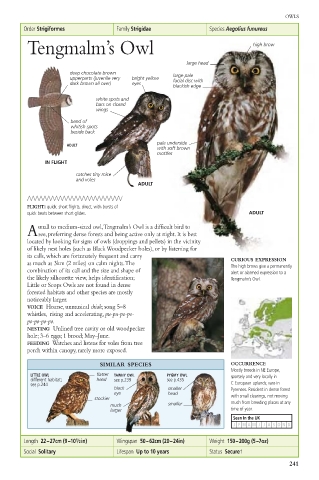
                                               large head
                  deep chocolate brown      large pale
                  upperparts (juvenile very  bright yellow  facial disc with
                  dark brown all over)  eyes
                                            blackish edge
                         white spots and
                         bars on closed
                         wings
                   band of
                   whitish spots
                   beside back
                                        pale underside
                  ADULT
                                        with soft brown
                                        mottles
            IN FLIGHT
                    catches tiny mice
                    and voles
                                   ADULT

        FLIGHT: quick, short flights, direct, with bursts of
        quick beats between short glides.                      ADULT
          small to medium-sized owl,Tengmalm’s Owl is a difficult bird to
        Asee, preferring dense forests and being active only at night. It is best
        located by looking for signs of owls (droppings and pellets) in the vicinity
        of likely nest holes (such as Black Woodpecker holes), or by listening for
        its calls, which are fortunately frequent and carry  CURIOUS EXPRESSION
        as much as 3km (2 miles) on calm nights.The       The high brows give a permanently
        combination of its call and the size and shape of  alert or alarmed expression to a
        the likely silhouette view, helps identification;  Tengmalm’s Owl.
        Little or Scops Owls are not found in dense
        forested habitats and other species are mostly
        noticeably larger.
        VOICE Hoarse, unmusical chiak; song 5–8
        whistles, rising and accelerating, pu-pu-po-po-
        po-po-po-po.
        NESTING Unlined tree cavity or old woodpecker
        hole; 3–6 eggs; 1 brood; May–June.
        FEEDING Watches and listens for voles from tree
        perch within canopy, rarely more exposed.
                          SIMILAR SPECIES                 OCCURRENCE
                                                          Mostly breeds in NE Europe,
         LITTLE OWL      flatter  TAWNY OWL  PYGMY OWL    sparsely and very locally in
         different habitat;  head  see p.239  see p.435
         see p.244                                        C European uplands, rare in
                             black         smaller        Pyrenees. Resident in dense forest
                             eye           head           with small clearings, not moving
                         stockier                         much from breeding places at any
                            much           smaller
                            larger                        time of year.
                                                           Seen in the UK
                                                           JF M A  M J  JA S ON D
       Length  22–27cm (9–10 1 ⁄2in)  Wingspan  50–62cm (20–24in)  Weight  150–200g (5–7oz)
       Social  Solitary       Lifespan  Up to 10 years  Status  Secure†
                                                                         241

