


Page 244 - Complete Birds of Britain and Europe (DK - RSPB)
P. 244
OWLS
       Order Strigiformes     Family Strigidae       Species Asio otus
        Long-eared Owl


                                                   long ear tufts,
                                                   raised
                 pale patch on
                 outer wings   dark surround to bright
                               orange-red eye               ear tufts, folded
                                                            back

                 mottled
                 upperwings
                  dark wrist
                  patch
                  grey tips

            IN FLIGHT
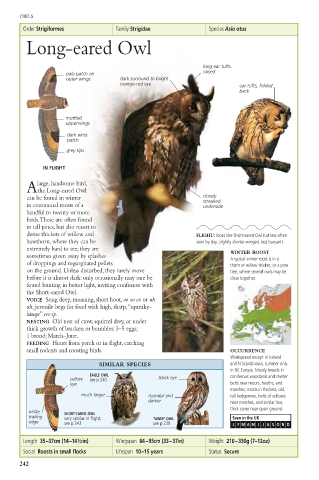
          large, handsome bird,
        Athe Long-eared Owl
        can be found in winter                     closely
                                                   streaked
        in communal roosts of a                    underside
        handful to twenty or more
        birds.These are often found
        in tall pines, but also resort to
        dense thickets of willow and              FLIGHT: looks like Short-eared Owl but less often
        hawthorn, where they can be               seen by day; slightly shorter-winged, less buoyant.
        extremely hard to see; they are                   WINTER ROOST
        sometimes given away by splashes                  A typical winter roost is in a
        of droppings and regurgitated pellets             thorn or willow thicket, or a pine
        on the ground. Unless disturbed, they rarely move  tree, where several owls may be
        before it is almost dark: only occasionally may one be  close together.
        found hunting in better light, inviting confusion with
        the Short-eared Owl.
        VOICE Song deep, moaning, short hoot, oo oo oo or uh
        uh; juvenile begs for food with high, sharp,“squeaky-
        hinge” eee-ip.
        NESTING Old nest of crow, squirrel drey, or under
        thick growth of bracken or brambles; 3–5 eggs;
        1 brood; March–June.
        FEEDING Hunts from perch or in flight, catching
        small rodents and roosting birds.                 OCCURRENCE
                                                          Widespread except in Iceland
                          SIMILAR SPECIES                 and N Scandinavia; summer only
                                                          in NE Europe. Mostly breeds in
                       EAGLE OWL                          coniferous woodland and shelter
                  yellow  see p.240     black eye
                  eye                                     belts near moors, heaths, and
                                                          marshes; roosts in thickets, old,
                     much larger      rounder and         tall hedgerows, belts of willows
                                      darker              near marshes, and similar low,
                                                          thick cover near open ground.
        white    SHORT-EARED OWL
        trailing  very similar in flight;   TAWNY OWL      Seen in the UK
        edge     see p.243             see p.239           J  F  M  A  M  JJ A S O  N  D
       Length  35–37cm (14–14 1 ⁄2in)  Wingspan  84–95cm (33–37in)  Weight  210–330g (7–12oz)
       Social  Roosts in small flocks  Lifespan  10–15 years  Status  Secure
      242

