


Page 256 - Complete Birds of Britain and Europe (DK - RSPB)
P. 256
KINGFISHERS, BEE-EATERS, ROLLERS,AND HOOPOE
       Order Coraciiformes    Family Meropidae       Species Merops apiaster
        Bee-eater

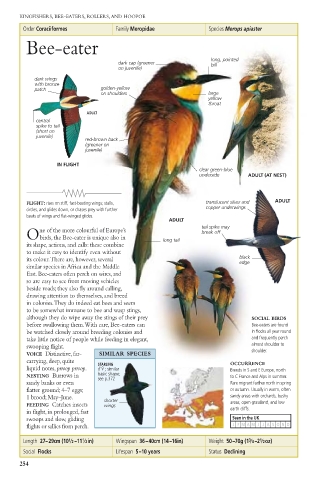
                                                     long, pointed
                              dark cap (greener      bill
                              on juvenile)
          dark wings
          with bronze
          patch           golden-yellow
                          on shoulders               large
                                                     yellow
                                                     throat
                       ADULT
          central
          spike to tail
          (short on
          juvenile)
                      red-brown back
                      (greener on
                      juvenile)
               IN FLIGHT
                                                  clear green-blue
                                                  underside    ADULT (AT NEST)

        FLIGHT: rises on stiff, fast-beating wings; stalls,  translucent silver and  ADULT
        circles, and glides down, or chases prey with further  copper underwings
        beats of wings and flat-winged glides.
                                           ADULT
                                                   tail spike may
           ne of the more colourful of Europe’s    break off
        Obirds, the Bee-eater is unique also in  long tail
        its shape, actions, and calls: these combine
        to make it easy to identify even without
        its colour.There are, however, several              black
                                                            edge
        similar species in Africa and the Middle
        East.Bee-eaters often perch on wires,and
        so are easy to see from moving vehicles
        beside roads; they also fly around calling,
        drawing attention to themselves, and breed
        in colonies.They do indeed eat bees and seem
        to be somewhat immune to bee and wasp stings,
        although they do wipe away the stings of their prey    SOCIAL BIRDS
        before swallowing them.With care, Bee-eaters can       Bee-eaters are found
        be watched closely around breeding colonies and        in flocks all year round
        take little notice of people while feeding in elegant,  and frequently perch
        swooping flight.                                       almost shoulder to
        VOICE Distinctive, far-  SIMILAR SPECIES               shoulder.
        carrying, deep, quite
                         STARLING                         OCCURRENCE
        liquid notes, prroop prroop.  32; similar         Breeds in S and E Europe, north
        NESTING Burrows in  basic shape;                  to C France and Alps in summer.
                         see p.372
        sandy banks or even                               Rare migrant farther north in spring
        flatter ground; 4–7 eggs;                         or autumn. Usually in warm, often
        1 brood; May–June.  shorter                       sandy areas with orchards, bushy
        FEEDING Catches insects  wings                    areas, open grassland, and low
        in flight, in prolonged, fast                     earth cliffs.
        swoops and slow, gliding                           Seen in the UK
        flights or sallies from perch.                     JF M A  M J  JA S ON D
       Length  27–29cm (10 1 ⁄2 –11 1 ⁄2in)  Wingspan  36–40cm (14–16in)  Weight  50–70g (1 3 ⁄4 –2 1 ⁄2oz)
       Social  Flocks         Lifespan  5–10 years   Status  Declining
      254

