


Page 257 - Complete Birds of Britain and Europe (DK - RSPB)
P. 257
KINGFISHERS, BEE-EATERS, ROLLERS,AND HOOPOE
       Order Coraciiformes    Family Coraciidae      Species Coracias garrulus
        Roller

                                                                 stout, pointed
                                                                 grey bill
                                                     greenish blue
                                                     head
                    dark purple-blue
                    on outer wings  duller, paler
                               body than
                               adult’s        faintly
                                              streaked
                                              chest
                     vivid turquoise on
                     inner wings
        square                             pale red-
        dark tail                          brown
                                           back
          ADULT
          (SUMMER)
              IN FLIGHT  IMMATURE (WINTER)                        green-blue
                                                                  underside
                                                              bright green-blue
                                                              closed wings
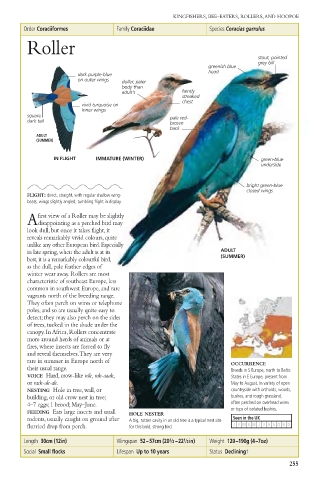
        FLIGHT: direct, straight, with regular shallow wing-
        beats, wings slightly angled; tumbling flight in display.
          first view of a Roller may be slightly
        Adisappointing as a perched bird may
        look dull, but once it takes flight, it
        reveals remarkably vivid colours, quite
        unlike any other European bird.Especially
        in late spring,when the adult is at its         ADULT
        best,it is a remarkably colourful bird,         (SUMMER)
        as the dull, pale feather edges of
        winter wear away. Rollers are most
        characteristic of southeast Europe, less
        common in southwest Europe, and rare
        vagrants north of the breeding range.
        They often perch on wires or telephone
        poles, and so are usually quite easy to
        detect; they may also perch on the sides
        of trees, tucked in the shade under the
        canopy. In Africa, Rollers concentrate
        more around herds of animals or at
        fires, where insects are forced to fly
        and reveal themselves.They are very
        rare in summer in Europe north of                 OCCURRENCE
        their usual range.                                Breeds in S Europe, north to Baltic
        VOICE Hard, crow-like rak, rak-aaak,              States in E Europe; present from
        or rack-ak-ak.                                    May to August. In variety of open
        NESTING Hole in tree, wall, or                    countryside with orchards, woods,
        building, or old crow nest in tree;               bushes, and rough grassland,
        4–7 eggs; 1 brood; May–June.                      often perched on overhead wires
        FEEDING Eats large insects and small  HOLE NESTER  or tops of isolated bushes.
        rodents, usually caught on ground after  A big, rotten cavity in an old tree is a typical nest site  Seen in the UK
        flurried drop from perch.  for this bold, strong bird.  JF M A  M J  JA S ON D
       Length  30cm (12in)    Wingspan  52–57cm (20 1 ⁄2 –22 1 ⁄2in)  Weight  120–190g (4–7oz)
       Social  Small flocks   Lifespan  Up to 10 years  Status  Declining†
                                                                         255

