


Page 260 - Complete Birds of Britain and Europe (DK - RSPB)
P. 260
WOODPECKERS AND WRYNECK
       Order Piciformes       Family Picidae         Species Dryocopus martius
        Black Woodpecker

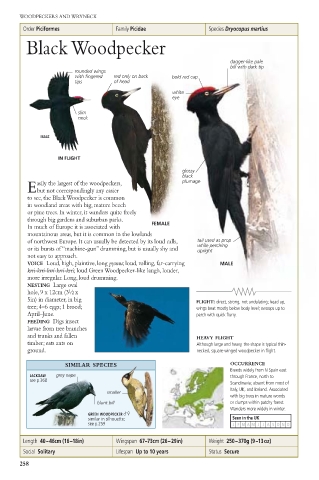
                                                          dagger-like pale
                                                          bill with dark tip
                    rounded wings
                    with fingered  red only on back  bold red cap
                    tips     of head
                                            white
                                            eye
                    slim
                    neck

           MALE

               IN FLIGHT
                                              glossy
                                              black
          asily the largest of the woodpeckers,  plumage
        Ebut not correspondingly any easier
        to see, the Black Woodpecker is common
        in woodland areas with big, mature beech
        or pine trees. In winter, it wanders quite freely
        through big gardens and suburban parks.
        In much of Europe it is associated with  FEMALE
        mountainous areas, but it is common in the lowlands
        of northwest Europe. It can usually be detected by its loud calls,  tail used as prop
        or its bursts of “machine-gun” drumming, but is usually shy and   while perching
                                                  upright
        not easy to approach.
        VOICE Loud, high, plaintive, long pyuuu; loud, rolling, far-carrying  MALE
        krri-krri-krri-krri-krri; loud Green Woodpecker-like laugh, louder,
        more irregular. Long, loud drumming.
        NESTING Large oval
                  1
        hole, 9 x 12cm (3 ⁄2 x
        5in) in diameter, in big                  FLIGHT: direct, strong, not undulating; head up,
        tree; 4–6 eggs; 1 brood;                  wings beat mostly below body level; swoops up to
        April–June.                               perch with quick flurry.
        FEEDING Digs insect
        larvae from tree branches
        and trunks and fallen                     HEAVY FLIGHT
        timber; eats ants on                      Although large and heavy, the shape is typical thin-
        ground.                                   necked, square-winged woodpecker in flight.
                 SIMILAR SPECIES                          OCCURRENCE
                                                          Breeds widely from N Spain east
        JACKDAW  grey nape                                through France, north to
        see p.368
                                                          Scandinavia; absent from most of
                                                          Italy, UK, and Iceland. Associated
                            smaller
                                                          with big trees in mature woods
                         blunt bill                       or clumps within patchy forest.
                                                          Wanders more widely in winter.
                       GREEN WOODPECKER 32
                       similar in silhouette;              Seen in the UK
                       see p.259                           JF M A  M J  JA S ON D
       Length  40–46cm (16–18in)  Wingspan  67–73cm (26–29in)  Weight  250–370g (9–13oz)
       Social  Solitary       Lifespan  Up to 10 years  Status  Secure
      258

