


Page 259 - Complete Birds of Britain and Europe (DK - RSPB)
P. 259
WOODPECKERS AND WRYNECK
        Family Picidae
        WOODPECKERS AND WRYNECK

            OST WOODPECKERS are tied to tree habitats
        Mbut accept a wide variety of species, age,
        and size of tree: the Great Spotted Woodpecker
        may feed in willow thickets in winter, but needs
        bigger branches in which to nest. Others feed
        on the ground: the Green Woodpecker, an
        ant-eater, feeds on grassland much more than
        in trees. Others, however, are more exacting
        and require large amounts of dead wood, and
        struggle to survive in modern forests with
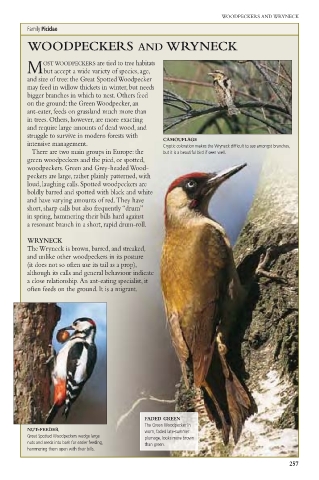
                                          CAMOUFLAGE
        intensive management.             Cryptic coloration makes the Wryneck difficult to see amongst branches,
         There are two main groups in Europe: the  but it is a beautiful bird if seen well.
        green woodpeckers and the pied, or spotted,
        woodpeckers. Green and Grey-headed Wood-
        peckers are large, rather plainly patterned, with
        loud, laughing calls. Spotted woodpeckers are
        boldly barred and spotted with black and white
        and have varying amounts of red.They have
        short, sharp calls but also frequently “drum”
        in spring, hammering their bills hard against
        a resonant branch in a short, rapid drum-roll.

        WRYNECK
        The Wryneck is brown, barred, and streaked,
        and unlike other woodpeckers in its posture
        (it does not so often use its tail as a prop),
        although its calls and general behaviour indicate
        a close relationship. An ant-eating specialist, it
        often feeds on the ground. It is a migrant.


                                     FADED GREEN
                                     The Green Woodpecker in
        NUT-FEEDER
                                     worn, faded late-summer
        Great Spotted Woodpeckers wedge large
                                     plumage, looks more brown
        nuts and seeds into bark for easier feeding,
                                     than green.
        hammering them open with their bills.
                                                                         257

