


Page 261 - Complete Birds of Britain and Europe (DK - RSPB)
P. 261
WOODPECKERS AND WRYNECK
       Order Piciformes       Family Picidae         Species Picus viridis
        Green Woodpecker


                                                        black moustache
                                      black around      with red centre
        greenish   barrel-shaped      whitish eye                  MALE
        yellow     body
        rump
                                  vivid red cap
                    whitish-barred,
                    dark wings    pale green
                                  cheek
         MALE
                    IN FLIGHT
                                      apple-green
        white spots                   upperside
        on dull green
        upperparts      blackish spots and
                        streaks on face
                        and underside
                       all-black
                       moustache
                                                greenish
                                                yellow rump
               JUVENILE
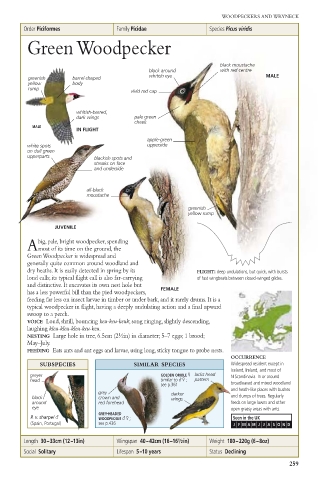
          big, pale, bright woodpecker, spending
        Amost of its time on the ground, the
        Green Woodpecker is widespread and
        generally quite common around woodland and
        dry heaths. It is easily detected in spring by its  FLIGHT: deep undulations, but quick, with bursts
        loud calls; its typical flight call is also far-carrying  of fast wingbeats between closed-winged glides.
        and distinctive. It excavates its own nest hole but
        has a less powerful bill than the pied woodpeckers,  FEMALE
        feeding far less on insect larvae in timber or under bark, and it rarely drums. It is a
        typical woodpecker in flight, having a deeply undulating action and a final upward
        swoop to a perch.
        VOICE Loud, shrill, bouncing keu-keu-keuk; song ringing, slightly descending,
        laughing kleu-kleu-kleu-keu-keu.
                              1
        NESTING Large hole in tree, 6.5cm (2 ⁄2in) in diameter; 5–7 eggs; 1 brood;
        May–July.
        FEEDING Eats ants and ant eggs and larvae,using long,sticky tongue to probe nests.
                                                          OCCURRENCE
           SUBSPECIES             SIMILAR SPECIES         Widespread resident except in
                                                          Iceland, Ireland, and most of
        greyer                           GOLDEN ORIOLE 2  lacks head  N Scandinavia. In or around
        head                             similar to 32;   pattern
                                         see p.361        broadleaved and mixed woodland
                                                          and heath-like places with bushes
                         grey               darker
         black           crown and          wings         and clumps of trees. Regularly
         around          red forehead                     feeds on large lawns and other
         eye                                              open grassy areas with ants.
         P. v. sharpei 3  GREY-HEADED                      Seen in the UK
                         WOODPECKER 32;
         (Spain, Portugal)  see p.436                      J  F  M  A  M  JJ A S O  N  D
       Length  30–33cm (12–13in)  Wingspan  40–42cm (16–16 1 ⁄2in)  Weight  180–220g (6–8oz)
       Social  Solitary       Lifespan  5–10 years   Status  Declining
                                                                         259

