


Page 264 - Complete Birds of Britain and Europe (DK - RSPB)
P. 264
WOODPECKERS AND WRYNECK
       Order Piciformes       Family Picidae         Species Dendrocopos minor
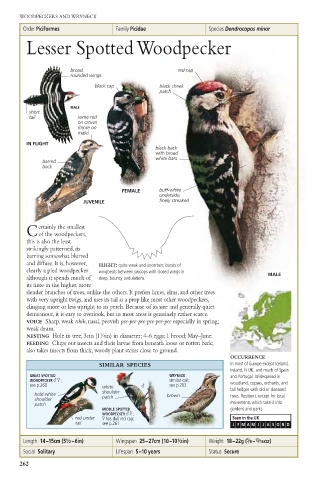
        Lesser Spotted Woodpecker


                   broad,                    red cap
                   rounded wings
                         black cap       black cheek
                                         patch
                   MALE
        short
        tail        some red
                    on crown
                    (more on
                    male)
        IN FLIGHT
                                        black back
                                        with broad
                                        white bars
            barred
            back
                               FEMALE    buff-white
                                         underside,
                      JUVENILE           finely streaked


           ertainly the smallest
        Cof the woodpeckers,
        this is also the least
        strikingly patterned, its
        barring somewhat blurred
        and diffuse. It is, however,  FLIGHT: quite weak and uncertain; bursts of
        clearly a pied woodpecker  wingbeats between swoops with closed wings in
        although it spends much of  deep, bouncy undulations.       MALE
        its time in the higher, more
        slender branches of trees, unlike the others. It prefers limes, elms, and other trees
        with very upright twigs,and uses its tail as a prop like most other woodpeckers,
        clinging more or less upright to its perch. Because of its size and generally quiet
        demeanour, it is easy to overlook, but in most areas is genuinely rather scarce.
        VOICE Sharp, weak tchik, nasal, peevish pee-pee-pee-pee-pee-pee especially in spring;
        weak drum.
                          1
        NESTING Hole in tree, 3cm (1 ⁄4in) in diameter; 4–6 eggs; 1 brood; May–June.
        FEEDING Chips out insects and their larvae from beneath loose or rotten bark;
        also takes insects from thick, woody plant stems close to ground.
                                                          OCCURRENCE
                          SIMILAR SPECIES                 In most of Europe except Iceland,
                                                          Ireland, N UK, and much of Spain
        GREAT SPOTTED                      WRYNECK        and Portugal. Widespread in
        WOODPECKER 32;                     similar call;  woodland, copses, orchards, and
        see p.260         white     3      see p.263
                          shoulder                        tall hedges with old or diseased
          bold white                      brown           trees. Resident, except for local
          shoulder        patch
          patch                                           movements which take it into
                          MIDDLE SPOTTED                  gardens and parks.
                          WOODPECKER 32;
                    red under  2has dull red cap;          Seen in the UK
                    tail  see p.261                        J  F  M  A  M  JJ A S O  N  D
       Length  14–15cm (5 1 ⁄2 –6in)  Wingspan  25–27cm (10–10 1 ⁄2in)  Weight  18–22g ( 5 ⁄8 – 13 ⁄16oz)
       Social  Solitary       Lifespan  5–10 years   Status  Secure
      262

