


Page 267 - Complete Birds of Britain and Europe (DK - RSPB)
P. 267
LARKS
       Order Passeriformes    Family Alaudidae       Species Alauda arvensis
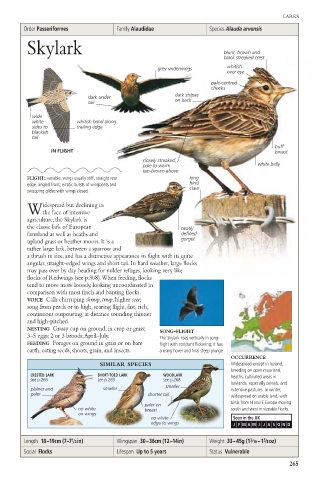
        Skylark                                          blunt, brown and

                                                         black streaked crest
                                                         whitish
                                        grey underwings
                                                         over eye
                                                     pale-centred
                                                     cheeks
                                            dark stripes
                       dark under
                       tail                 on back
         wide
         white      whitish band along
         sides to   trailing edge
         blackish
         tail
                                                                     buff
              IN FLIGHT                                              breast
                                     closely streaked,
                                     pale to warm                white belly
                                     tan-brown above
        FLIGHT: variable, wings usually stiff, straight rear  long
        edge, angled front; erratic bursts of wingbeats and  hind
        swooping glides with wings closed.      claw
            idespread but declining in
        Wthe face of intensive
        agriculture, the Skylark is
        the classic lark of European          neatly
        farmland as well as heaths and        defined
        upland grass or heather moors. It is a  gorget
        rather large lark, between a sparrow and
        a thrush in size, and has a distinctive appearance in flight with its quite
        angular, straight-edged wings and short tail. In hard weather, large flocks
        may pass over by day heading for milder refuges, looking very like
        flocks of Redwings (see p.308).When feeding, flocks
        tend to move more loosely, looking uncoordinated in
        comparison with most finch and bunting flocks.
        VOICE Calls chirruping shrrup, trrup, higher seee;
        song from perch or in high, soaring flight, fast, rich,
        continuous outpouring, at distance sounding thinner
        and high-pitched.
        NESTING Grassy cup on ground, in crop or grass;  SONG-FLIGHT
        3–5 eggs; 2 or 3 broods;April–July.  The Skylark rises vertically in song-
        FEEDING Forages on ground in grass or on bare  flight with constant flickering; it has
        earth, eating seeds, shoots, grain, and insects.  a rising hover and final steep plunge.
                                                          OCCURRENCE
                          SIMILAR SPECIES                 Widespread except in Iceland,
                                                          breeding on open moorland,
         CRESTED LARK    SHORT-TOED LARK  WOODLARK        heaths, cultivated areas in
         see p.266       see p.269        see p.268       lowlands, especially cereals, and
                                          smaller
         plainer and       smaller                        extensive pastures. In winter,
         paler                        shorter tail        widespread on arable land, with
                                                          birds from N and E Europe moving
                                     paler on
                    no white         breast               south and west in sizeable flocks.
                    on wings
                                       no white            Seen in the UK
                                       edge to wings       J  F  M  A  M  JJ A S O  N  D
       Length  18–19cm (7–7 1 ⁄2in)  Wingspan  30–36cm (12–14in)  Weight  33–45g (1 3 ⁄16 –1 5 ⁄8oz)
       Social  Flocks         Lifespan  Up to 5 years  Status  Vulnerable
                                                                         265

