


Page 265 - Complete Birds of Britain and Europe (DK - RSPB)
P. 265
WOODPECKERS AND WRYNECK
       Order Piciformes       Family Picidae         Species Jynx torquilla
        Wryneck
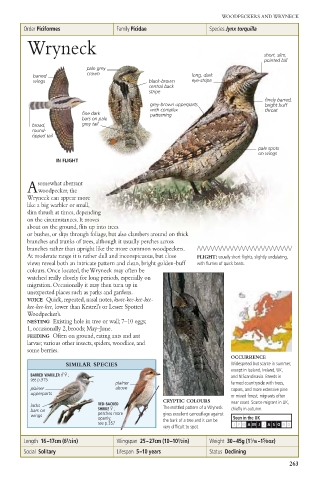
                                                                   short, slim,
                                                                   pointed bill
                       pale grey
                       crown
         barred                                  long, dark
         wings                        black-brown  eye-stripe
                                      central back
                                      stripe
                                                                   finely barred,
                                      grey-brown upperparts        bright buff
                                      with complex                 throat
                     fine dark        patterning
                     bars on pale
         broad,      grey tail
         round-
         tipped tail
                                                                 pale spots
                                                                 on wings
               IN FLIGHT
          somewhat aberrant
        Awoodpecker, the
        Wryneck can appear more
        like a big warbler or small,
        slim thrush at times, depending
        on the circumstances. It moves
        about on the ground, flits up into trees
        or bushes, or slips through foliage, but also clambers around on thick
        branches and trunks of trees, although it usually perches across
        branches rather than upright like the more common woodpeckers.
        At moderate range it is rather dull and inconspicuous, but close  FLIGHT: usually short flights, slightly undulating,
        views reveal both an intricate pattern and clean, bright golden-buff  with flurries of quick beats.
        colours. Once located, the Wryneck may often be
        watched really closely for long periods, especially on
        migration. Occasionally it may then turn up in
        unexpected places such as parks and gardens.
        VOICE Quick, repeated, nasal notes, kwee-kee-kee-kee-
        kee-kee-kee, lower than Kestrel’s or Lesser Spotted
        Woodpecker’s.
        NESTING Existing hole in tree or wall; 7–10 eggs;
        1, occasionally 2, broods; May–June.
        FEEDING Often on ground, eating ants and ant
        larvae; various other insects, spiders, woodlice, and
        some berries.
                                                          OCCURRENCE
                 SIMILAR SPECIES                          Widespread but scarce in summer,
                                                          except in Iceland, Ireland, UK,
         BARRED WARBLER 32;                               and N Scandinavia. Breeds in
         see p.315
                              plainer                     farmed countryside with trees,
         plainer              above                       copses, and more extensive pine
         upperparts
                                                          or mixed forest; migrants often
                                          CRYPTIC COLOURS  near coast. Scarce migrant in UK,
         lacks           RED-BACKED       The mottled pattern of a Wryneck
         bars on         SHRIKE 2;                        chiefly in autumn.
         wings           perches more     gives excellent camouflage against
                         openly;          the bark of a tree and it can be  Seen in the UK
                         see p.357                         J  F  M  A  M  J J AS O  N  D
                                          very difficult to spot.
       Length  16–17cm (6 1 ⁄2in)  Wingspan  25–27cm (10–10 1 ⁄2in)  Weight  30–45g (1 1 ⁄16 –1 5 ⁄8oz)
       Social  Solitary       Lifespan  5–10 years   Status  Declining
                                                                         263

