


Page 268 - Complete Birds of Britain and Europe (DK - RSPB)
P. 268
LARKS
       Order Passeriformes    Family Alaudidae       Species Galerida cristata
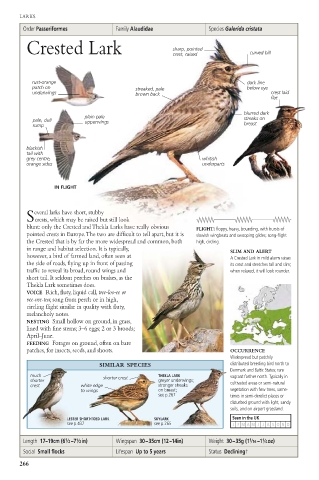
        Crested Lark                        sharp, pointed     curved bill
                                            crest, raised


         rust-orange                                          dark line
         patch on                  streaked, pale             below eye
         underwings                brown back                       crest laid
                                                                    flat
                                                              blurred dark
                      plain pale
         pale, dull   upperwings                              streaks on
         rump                                                 breast

        blackish
        tail with
        grey centre,                               whitish
        orange sides                               underparts

               IN FLIGHT

          everal larks have short, stubby
        Scrests, which may be raised but still look
        blunt: only the Crested and Thekla Larks have really obvious  FLIGHT: floppy, heavy, bounding, with bursts of
        pointed crests in Europe.The two are difficult to tell apart, but it is  slowish wingbeats and swooping glides; song-flight
        the Crested that is by far the more widespread and common, both  high, circling.
        in range and habitat selection. It is typically,  SLIM AND ALERT
        however, a bird of farmed land, often seen at     A Crested Lark in mild alarm raises
        the side of roads, flying up in front of passing   its crest and stretches tall and slim;
        traffic to reveal its broad, round wings and      when relaxed, it will look rounder.
        short tail. It seldom perches on bushes, as the
        Thekla Lark sometimes does.
        VOICE Rich, fluty, liquid call, tree-loo-ee or
        vee-vee-teu; song from perch or in high,
        circling flight similar in quality with fluty,
        melancholy notes.
        NESTING Small hollow on ground, in grass,
        lined with fine stems; 3–6 eggs; 2 or 3 broods;
        April–June.
        FEEDING Forages on ground, often on bare
        patches, for insects, seeds, and shoots.          OCCURRENCE
                                                          Widespread but patchily
                          SIMILAR SPECIES                 distributed breeding bird north to
                                                          Denmark and Baltic States; rare
         much              shorter crest  THEKLA LARK     vagrant farther north. Typically in
         shorter                        greyer underwings;  cultivated areas or semi-natural
         crest       white edge         stronger streaks
                     to wings           on breast;        vegetation with few trees, some-
                                        see p.267         times in semi-derelict places or
                                                          disturbed ground with light, sandy
                                                          soils, and on airport grassland.
                  LESSER SHORT-TOED LARK  SKYLARK          Seen in the UK
                  see p.437            see p.265           JF M A  M J  JA S ON D
       Length  17–19cm (6 1 ⁄2 –7 1 ⁄2in)  Wingspan  30–35cm (12–14in)  Weight  30–35g (1 1 ⁄16 –1 1 ⁄4oz)
       Social  Small flocks   Lifespan  Up to 5 years  Status  Declining†
      266

