


Page 266 - Complete Birds of Britain and Europe (DK - RSPB)
P. 266
LARKS
        Family Alaudidae
        LARKS

          LMOST EXCLUSIVELY GROUND birds, except
        Awhen singing, larks are quite stocky but
        long-bodied birds, bulkier than pipits or wagtails,
        but less chunky than most finches.They have
        thick, triangular bills – between the insect-eating
        bill of a pipit and the seed-eating bill of a finch,
        reflecting their varied diet.They fly strongly,with
        quite long, often rather angular wings.
         Larks have faintly short legs but long toes and
        claws, especially the claws on their hind toes,
        which seem to be an adaptation for walking
        through grassy vegetation.They move easily
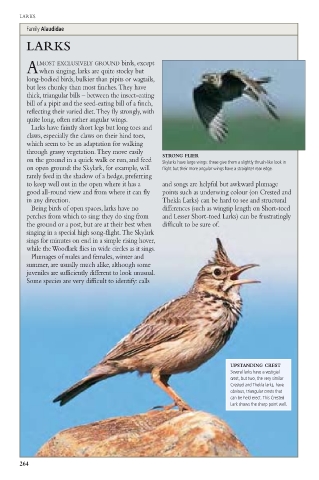
                                         STRONG FLIER
        on the ground in a quick walk or run, and feed  Skylarks have large wings: these give them a slightly thrush-like look in
        on open ground: the Skylark, for example, will  flight but their more angular wings have a straighter rear edge.
        rarely feed in the shadow of a hedge, preferring
        to keep well out in the open where it has a  and songs are helpful but awkward plumage
        good all-round view and from where it can fly  points such as underwing colour (on Crested and
        in any direction.                Thekla Larks) can be hard to see and structural
         Being birds of open spaces, larks have no  differences (such as wingtip length on Short-toed
        perches from which to sing: they do sing from  and Lesser Short-toed Larks) can be frustratingly
        the ground or a post, but are at their best when  difficult to be sure of.
        singing in a special high song-flight.The Skylark
        sings for minutes on end in a simple rising hover,
        while the Woodlark flies in wide circles as it sings.
         Plumages of males and females, winter and
        summer, are usually much alike, although some
        juveniles are sufficiently different to look unusual.
        Some species are very difficult to identify: calls


                                                          UPSTANDING CREST
                                                          Several larks have a vestigial
                                                          crest, but two, the very similar
                                                          Crested and Thekla larks, have
                                                          obvious, triangular crests that
                                                          can be held erect. This Crested
                                                          Lark shows the sharp point well.


      264

