


Page 399 - Complete Birds of Britain and Europe (DK - RSPB)
P. 399
BUNTINGS
       Order Passeriformes    Family Emberizidae     Species Emberiza hortulana
        Ortolan Bunting                                    pale eye-ring

                                                            pink bill
                                                     brighter buff
                                   yellow eye-ring   than female


                             green head
        olive-      MALE
        buff        (SUMMER)
        rump                                       yellow
                                                   moustache
                                                                 JUVENILE
                                                   pale green  sharp,
                                                   chest      triangular bill
               IN FLIGHT
                                                      pale eye-ring
                                                    greyer than
                                             orange  juvenile
                                             underside
           black tail with
           white sides
           MALE
           (SUMMER)                                           FEMALE

           ale Ortolans sing from bushes or trees on warm open slopes
        Mor in areas of upland pasture with hedges, walls, and copses.  FLIGHT: flitting, undulating, with bursts of
        Their persistence makes up for a lack of real musical quality. Ortolan  relatively weak wingbeats; straighter over long
        Buntings are also scarce but regular migrants in many coastal areas.  distance with longer, shallow undulations.
        They are usually quite shy and quick to fly off but tend
        to feed in open, grassy places where they can be
        watched from a distance.They are slim, pale buntings
        with sharp pink bills and obvious pale eye-rings.
        VOICE Call thick, metallic, dl-ip and chu; song fluty,
        simple, ringing phrase, often repeated several times then
        changed to higher pitch, sia sia sia si sia sru sru sru sru.
        NESTING Simple, hair-lined nest of grass and straw, on
        or near ground; 4–6 eggs; 2 or 3 broods;April–July.
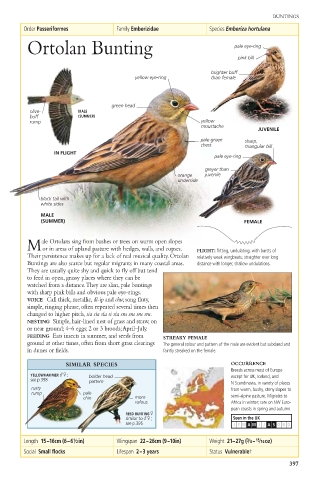
        FEEDING Eats insects in summer, and seeds from  STREAKY FEMALE
        ground at other times, often from short grass clearings  The general colour and pattern of the male are evident but subdued and
        in dunes or fields.               faintly streaked on the female.
                 SIMILAR SPECIES                          OCCURRENCE
                                                          Breeds across most of Europe
         YELLOWHAMMER 32;  bolder head                    except for UK, Iceland, and
         see p.398     pattern                            N Scandinavia, in variety of places
         rusty                                            from warm, bushy, stony slopes to
         rump         pale                                semi-alpine pasture. Migrates to
                      chin         more
                                   rufous                 Africa in winter; rare on NW Euro-
                                                          pean coasts in spring and autumn.
                                REED BUNTING 2
                                similar to 32;             Seen in the UK
                                see p.395                  JF M A  M J  J AS ON D
       Length  15–16cm (6–6 1 ⁄2in)  Wingspan  22–26cm (9–10in)  Weight  21–27g ( 3 ⁄4 – 15 ⁄16oz)
       Social  Small flocks   Lifespan  2–3 years    Status  Vulnerable†
                                                                         397

