


Page 398 - Complete Birds of Britain and Europe (DK - RSPB)
P. 398
BUNTINGS
       Order Passeriformes    Family Emberizidae     Species Emberiza pusilla
        Little Bunting                                         blackish
                                                               sides of
                                                    pale eye-ring  crown  rust-red
                                                                    crown
                                                                    and face
                                              blackish corners
                     greyish forewings        of cheeks
                     (rufous on Reed
                     Bunting)
                                   buff, brown, and black
                                   streaks on back                  sharp,
                                                                    straight-
                                                                    edged
                   MALE        white edge                           bill
                   (SUMMER)    of tail
                     pale crown                                     white
                     stripe                                         underside
                                                                    with dark
                                       rufous face                  streaks
             IN FLIGHT
           greyish
           shoulders                      pale legs
        MALE                                                     MALE
        (WINTER)                                                 (SUMMER)

                                        FEMALE


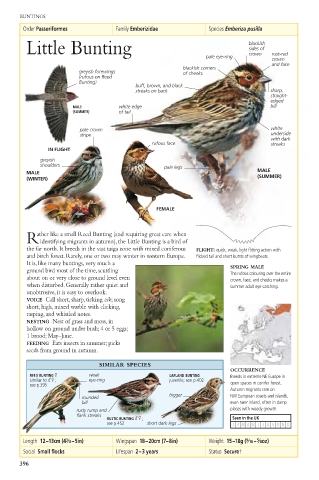
          ather like a small Reed Bunting (and requiring great care when
        Ridentifying migrants in autumn), the Little Bunting is a bird of
        the far north. It breeds in the vast taiga zone with mixed coniferous  FLIGHT: quick, weak, light flitting action with
        and birch forest. Rarely, one or two may winter in western Europe.  flicked tail and short bursts of wingbeats.
        It is, like many buntings, very much a
        ground bird most of the time, scuttling           SPRING MALE
                                                          The rufous colouring over the entire
        about on or very close to ground level even       crown, face, and cheeks makes a
        when disturbed. Generally rather quiet and        summer adult eye-catching.
        unobtrusive, it is easy to overlook.
        VOICE Call short, sharp, ticking zik; song
        short, high, mixed warble with clicking,
        rasping, and whistled notes.
        NESTING Nest of grass and moss, in
        hollow on ground under bush; 4 or 5 eggs;
        1 brood; May–June.
        FEEDING Eats insects in summer; picks
        seeds from ground in autumn.
                          SIMILAR SPECIES
                                                          OCCURRENCE
        REED BUNTING 2  weak               LAPLAND BUNTING  Breeds in extreme NE Europe in
        similar to 32;  eye-ring           juvenile; see p.402  open spaces in conifer forest.
        see p.395
                                                          Autumn migrants rare on
                                           bigger         NW European coasts and islands,
                     rounded
                     bill                                 even rarer inland, often in damp
                    rusty rump and                        places with weedy growth.
                    flank streaks
                            RUSTIC BUNTING 32;             Seen in the UK
                            see p.452  short dark legs     J F M A M JJ A S  O N D
       Length  12–13cm (4 3 ⁄4 –5in)  Wingspan  18–20cm (7–8in)  Weight  15–18g ( 9 ⁄16 – 5 ⁄8oz)
       Social  Small flocks   Lifespan  2–3 years    Status  Secure†
      396

