


Page 421 - Complete Birds of Britain and Europe (DK - RSPB)
P. 421
CRAKES AND COOTS
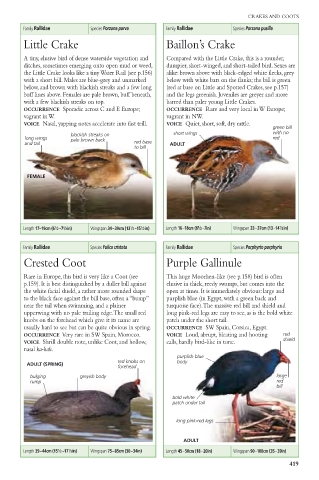
       Family Rallidae  Species Porzana parva  Family Rallidae  Species Porzana pusilla
       Little Crake                       Baillon’s Crake

       A tiny, elusive bird of dense waterside vegetation and  Compared with the Little Crake, this is a rounder,
       ditches, sometimes emerging onto open mud or weed,  dumpier, short-winged, and short-tailed bird. Sexes are
       the Little Crake looks like a tiny Water Rail (see p.156)  alike: brown above with black-edged white flecks, grey
       with a short bill. Males are blue-grey and unmarked  below with white bars on the flanks; the bill is green
       below, and brown with blackish streaks and a few long  (red at base on Little and Spotted Crakes, see p.157)
       buff lines above. Females are pale brown, buff beneath,  and the legs greenish. Juveniles are greyer and more
       with a few blackish streaks on top.  barred than paler young Little Crakes.
       OCCURRENCE Sporadic across C and E Europe;  OCCURRENCE Rare and very local in W Europe;
       vagrant in W.                      vagrant in NW.
       VOICE Nasal, yapping notes accelerate into fast trill.  VOICE Quiet, short, soft, dry rattle.
                                                                     green bill
                   blackish streaks on      short wings              with no
       long wings  pale brown back                                   red
       and tail                   red base  ADULT
                                  to bill

        FEMALE


       Length 17–19cm (6 1 ⁄2 –7 1 ⁄2in)  Wingspan 34–39cm (13 1 ⁄2 –15 1 ⁄2in)  Length 16–18cm (6 1 ⁄2 –7in)  Wingspan 33–37cm (13–14 1 ⁄2in)

       Family Rallidae  Species Fulica cristata  Family Rallidae  Species Porphyrio porphyrio
       Crested Coot                       Purple Gallinule
       Rare in Europe, this bird is very like a Coot (see  This huge Moorhen-like (see p.158) bird is often
       p.159). It is best distinguished by a duller bill against  elusive in thick, reedy swamps, but comes into the
       the white facial shield, a rather more rounded shape   open at times. It is immediately obvious: large and
       to the black face against the bill base, often a “bump”  purplish blue (in Egypt, with a green back and
       near the tail when swimming, and a plainer  turquoise face).The massive red bill and shield and
       upperwing with no pale trailing edge.The small red  long pink-red legs are easy to see, as is the bold white
       knobs on the forehead which give it its name are  patch under the short tail.
       usually hard to see but can be quite obvious in spring.  OCCURRENCE SW Spain, Corsica, Egypt.
       OCCURRENCE Very rare in SW Spain, Morocco.  VOICE Loud, abrupt, bleating and hooting   red
                                                                       shield
       VOICE Shrill double note, unlike Coot, and hollow,  calls, hardly bird-like in tone.
       nasal ka-hah.
                                             purplish blue
                              red knobs on   body
        ADULT (SPRING)
                              forehead
         bulging     greyish body                                     large
         rump                                                         red
                                                                      bill
                                            bold white
                                            patch under tail
                                             long pink-red legs

                                               ADULT
       Length 39–44cm (15 1 ⁄2 –17 1 ⁄2in)  Wingspan 75–85cm (30–34in)  Length 45–50cm (18–20in)  Wingspan 90–100cm (35–39in)
                                                                         419

