


Page 424 - Complete Birds of Britain and Europe (DK - RSPB)
P. 424
WADERS
       Family Charadriidae  Species Charadrius leschenaultii  Family Charadriidae  Species Charadrius asiaticus
       Greater Sand Plover                Caspian Plover
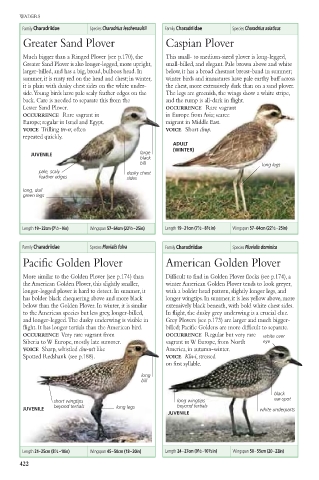
       Much bigger than a Ringed Plover (see p.170), the  This small- to medium-sized plover is long-legged,
       Greater Sand Plover is also longer-legged,more upright,  small-billed, and elegant. Pale brown above and white
       larger-billed, and has a big, broad, bulbous head. In  below, it has a broad chestnut breast-band in summer;
       summer,it is rusty red on the head and chest;in winter,  winter birds and immatures have pale earthy buff across
       it is plain with dusky chest sides on the white under-  the chest, more extensively dark than on a sand plover.
       side.Young birds have pale scaly feather edges on the  The legs are greenish, the wings show a white stripe,
       back. Care is needed to separate this from the  and the rump is all-dark in flight.
       Lesser Sand Plover.                OCCURRENCE Rare vagrant
       OCCURRENCE Rare vagrant in         in Europe from Asia; scarce
       Europe;regular in Israel and Egypt.  migrant in Middle East.
       VOICE Trilling trr-rr, often       VOICE Short chup.
       repeated quickly.
                                            ADULT
                                            (WINTER)
         JUVENILE                   large
                                    black
                                    bill                          long legs
           pale, scaly           dusky chest
           feather edges         sides
       long, dull
       green legs


       Length 19–22cm (7 1 ⁄2 –9in)  Wingspan 57–64cm (22 1 ⁄2 –25in)  Length 19–21cm (7 1 ⁄2 –8 1 ⁄2in)  Wingspan 57–64cm (22 1 ⁄2 –25in)

       Family Charadriidae  Species Pluvialis fulva  Family Charadriidae  Species Pluvialis dominica
       Pacific Golden Plover              American Golden Plover
       More similar to the Golden Plover (see p.174) than  Difficult to find in Golden Plover flocks (see p.174), a
       the American Golden Plover, this slightly smaller,  winter American Golden Plover tends to look greyer,
       longer-legged plover is hard to detect. In summer, it  with a bolder head pattern, slightly longer legs, and
       has bolder black chequering above and more black  longer wingtips.In summer,it is less yellow above,more
       below than the Golden Plover. In winter, it is similar  extensively black beneath, with bold white chest sides.
       to the American species but less grey, longer-billed,  In flight, the dusky grey underwing is a crucial clue.
       and longer-legged.The dusky underwing is visible in  Grey Plovers (see p.173) are larger and much bigger-
       flight. It has longer tertials than the American bird.  billed; Pacific Goldens are more difficult to separate.
       OCCURRENCE Very rare vagrant from  OCCURRENCE Regular but very rare  white over
       Siberia to W Europe, mostly late summer.  vagrant in W Europe, from North  eye
       VOICE Sharp, whistled chu-wit like  America,in autumn-winter.
       Spotted Redshank (see p.188).      VOICE Klu-i,stressed
                                          on first syllable.
                                    long
                                    bill
                                                                     black
              short wingtips                 long wingtips           ear-spot
              beyond tertials  long legs     beyond tertials
       JUVENILE                                                   white underparts
                                           JUVENILE


       Length 21–25cm (8 1 ⁄2 –10in)  Wingspan 45–50cm (18–20in)  Length 24–27cm (9 1 ⁄2 –10 1 ⁄2in)  Wingspan 50–55cm (20–22in)
      422

