


Page 422 - Complete Birds of Britain and Europe (DK - RSPB)
P. 422
CRANES/WADERS
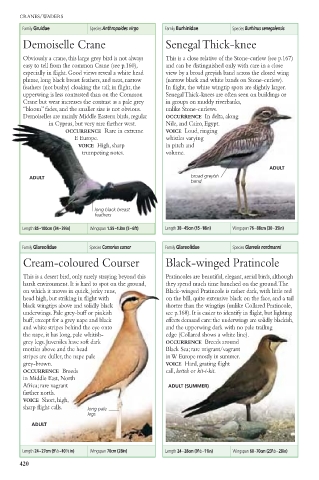
       Family Gruidae  Species Anthropoides virgo  Family Burhinidae  Species Burhinus senegalensis
       Demoiselle Crane                   Senegal Thick-knee

       Obviously a crane, this large grey bird is not always  This is a close relative of the Stone-curlew (see p.167)
       easy to tell from the common Crane (see p.160),  and can be distinguished only with care in a close
       especially in flight. Good views reveal a white head  view by a broad greyish band across the closed wing
       plume, long black breast feathers, and neat, narrow  (narrow black and white bands on Stone-curlew).
       feathers (not bushy) cloaking the tail; in flight, the  In flight, the white wingtip spots are slightly larger.
       upperwing is less contrasted than on the Common  Senegal Thick-knees are often seen on buildings or
       Crane but wear increases the contrast as a pale grey  in groups on muddy riverbanks,
       “bloom” fades, and the smaller size is not obvious.  unlike Stone-curlews.
       Demoiselles are mainly Middle Eastern birds, regular  OCCURRENCE In delta, along
             in Cyprus, but very rare farther west.  Nile, and Cairo, Egypt.
                 OCCURRENCE Rare in extreme   VOICE Loud, ringing
                   E Europe.              whistles varying
                    VOICE High, sharp     in pitch and
                     trumpeting notes.    volume.

                                                                    ADULT
        ADULT                                   broad greyish
                                                band


                         long black breast
                         feathers
       Length 85–100cm (34–39in)  Wingspan 1.55–1.8m (5–6ft)  Length 38–45cm (15–18in)   Wingspan 76–88cm (30–35in)

       Family Glareolidae  Species Cursorius cursor  Family Glareolidae  Species Glareola nordmanni
       Cream-coloured Courser             Black-winged Pratincole
       This is a desert bird, only rarely straying beyond this  Pratincoles are beautiful, elegant, aerial birds, although
       harsh environment. It is hard to spot on the ground,  they spend much time hunched on the ground.The
       on which it moves in quick, jerky runs,  Black-winged Pratincole is rather dark, with little red
       head high, but striking in flight with  on the bill, quite extensive black on the face, and a tail
       black wingtips above and solidly black  shorter than the wingtips (unlike Collared Pratincole,
       underwings. Pale grey-buff or pinkish  see p.168). It is easier to identify in flight, but lighting
       buff, except for a grey nape and black  effects demand care:the underwings are solidly blackish,
       and white stripes behind the eye onto  and the upperwing dark with no pale trailing
       the nape, it has long, pale whitish-  edge (Collared shows a white line).
       grey legs. Juveniles have soft dark  OCCURRENCE Breeds around
       mottles above and the head         Black Sea; rare migrant/vagrant
       stripes are duller, the nape pale  in W Europe mostly in summer.
       grey-brown.                        VOICE Hard, grating flight
       OCCURRENCE Breeds                  call, kettek or kit-i-kit.
       in Middle East, North
       Africa; rare vagrant                ADULT (SUMMER)
       farther north.
       VOICE Short,high,
       sharp flight calls.  long pale
                       legs
         ADULT


       Length 24–27cm (9 1 ⁄2 –10 1 ⁄2in)   Wingspan 70cm (28in)  Length 24–28cm (9 1 ⁄2 –11in)   Wingspan 60–70cm (23 1 ⁄2 –28in)
      420

