


Page 423 - Complete Birds of Britain and Europe (DK - RSPB)
P. 423
WADERS
       Family Glareolidae  Species Glareola maldivarium  Family Charadriidae  Species  Charadrius semipalmatus
       Oriental Pratincole                Semipalmated Plover

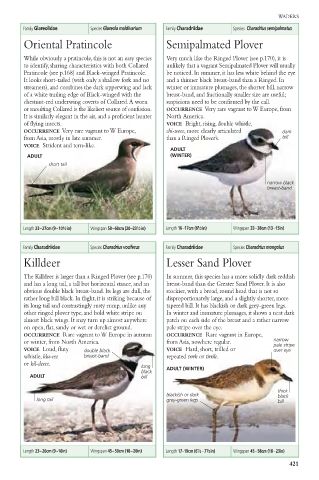
       While obviously a pratincole, this is not an easy species  Very much like the Ringed Plover (see p.170), it is
       to identify, sharing characteristics with both Collared  unlikely that a vagrant Semipalmated Plover will usually
       Pratincole (see p.168) and Black-winged Pratincole.  be noticed. In summer, it has less white behind the eye
       It looks short-tailed (with only a shallow fork and no  and a thinner black breast-band than a Ringed. In
       streamers), and combines the dark upperwing and lack  winter or immature plumages, the shorter bill, narrow
       of a white trailing edge of Black-winged with the  breast-band, and fractionally smaller size are useful;
       chestnut-red underwing coverts of Collared.A worn  suspicions need to be confirmed by the call.
       or moulting Collared is the likeliest source of confusion.  OCCURRENCE Very rare vagrant to W Europe, from
       It is similarly elegant in the air, and a proficient hunter  North America.
       of flying insects.                 VOICE Bright,rising,double whistle,
       OCCURRENCE Very rare vagrant to W Europe,  chi-weee, more clearly articulated  dark
       from Asia, mostly in late summer.  than a Ringed Plover’s.      bill
       VOICE Strident and tern-like.
                                           ADULT
        ADULT                              (WINTER)
             short tail

                                                                   narrow black
                                                                   breast-band


       Length 23–27cm (9–10 1 ⁄2in)   Wingspan 50–60cm (20–23 1 ⁄2in)  Length 16–17cm (6 1 ⁄2in)   Wingspan 33–38cm (13–15in)

       Family Charadriidae  Species Charadrius vociferus  Family Charadriidae  Species Charadrius mongolus
       Killdeer                           Lesser Sand Plover
       The Killdeer is larger than a Ringed Plover (see p.170)  In summer, this species has a more solidly dark reddish
       and has a long tail, a tall but horizontal stance, and an  breast-band than the Greater Sand Plover. It is also
       obvious double black breast-band. Its legs are dull, the  stockier, with a broad, round head that is not so
       rather long bill black. In flight, it is striking because of  disproportionately large, and a slightly shorter, more
       its long tail and contrastingly rusty rump, unlike any  tapered bill. It has blackish or dark grey-green legs.
       other ringed plover type, and bold white stripe on  In winter and immature plumages, it shows a neat dark
       almost black wings. It may turn up almost anywhere  patch on each side of the breast and a rather narrow
       on open, flat, sandy or wet or derelict ground.  pale stripe over the eye.
       OCCURRENCE Rare vagrant to W Europe in autumn  OCCURRENCE Rare vagrant in Europe,
                                                                     narrow
       or winter, from North America.     from Asia, nowhere regular.
                                                                     pale stripe
       VOICE Loud, fluty   double black   VOICE Hard, short, trilled or   over eye
       whistle, klu-eee  breast-band      repeated trrrk or tirrik.
       or kil-deeee.
                                    long  ADULT (WINTER)
                                    black
        ADULT                       bill
                                                                      thick
                                          blackish or dark            black
          long tail                       grey-green legs             bill


       Length 23–26cm (9–10in)   Wingspan 45–50cm (18–20in)  Length 17–19cm (6 1 ⁄2 –7 1 ⁄2in)   Wingspan 45–58cm (18–23in)
                                                                         421

