


Page 426 - Complete Birds of Britain and Europe (DK - RSPB)
P. 426
WADERS
       Family Scolopacidae  Species Xenus cinereus  Family Scolopacidae  Species Calidris minutilla
       Terek Sandpiper                    Least Sandpiper
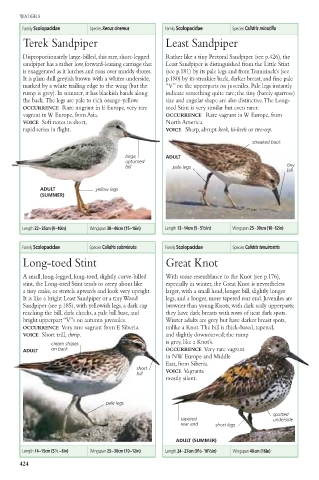
       Disproportionately large-billed, this rare, short-legged  Rather like a tiny Pectoral Sandpiper (see p.426), the
       sandpiper has a rather low,forward-leaning carriage that  Least Sandpiper is distinguished from the Little Stint
       is exaggerated as it lurches and runs over muddy shores.  (see p.181) by its pale legs and from Temminck’s (see
       It is plain dull greyish brown with a whiter underside,  p.180) by its streakier back, darker breast, and fine pale
       marked by a white trailing edge to the wing (but the  “V” on the upperparts on juveniles. Pale legs instantly
       rump is grey). In summer, it has blackish bands along  indicate something quite rare; the tiny (barely sparrow)
       the back.The legs are pale to rich orange-yellow.  size and angular shape are also distinctive.The Long-
       OCCURRENCE Rare migrant in E Europe, very rare  toed Stint is very similar but even rarer.
       vagrant in W Europe, from Asia.    OCCURRENCE Rare vagrant in W Europe, from
       VOICE Soft notes in short,         North America.
       rapid series in flight.            VOICE Sharp, abrupt keek, ki-keek or tree-eep.
                                                                streaked back
                                large,    ADULT
                                upturned
                                bill        pale legs                   tiny
                                                                        bill
           ADULT         yellow legs
           (SUMMER)


       Length 22–25cm (9–10in)  Wingspan 38–40cm (15–16in)  Length 13–14cm (5–5 1 ⁄2in)   Wingspan 25–30cm (10–12in)

       Family Scolopacidae  Species Calidris subminuta  Family Scolopacidae  Species Calidris tenuirostris
       Long-toed Stint                    Great Knot
       A small, long-legged, long-toed, slightly curve-billed  With some resemblance to the Knot (see p.176),
       stint, the Long-toed Stint tends to creep about like   especially in winter, the Great Knot is nevertheless
       a tiny crake, or stretch upwards and look very upright.  larger, with a small head, longer bill, slightly longer
       It is like a bright Least Sandpiper or a tiny Wood  legs, and a longer, more tapered rear end. Juveniles are
       Sandpiper (see p.185), with yellowish legs, a dark cap  browner than young Knots, with dark scaly upperparts;
       reaching the bill, dark cheeks, a pale bill base, and  they have dark breasts with rows of neat dark spots.
       bright upperpart “V”s on autumn juveniles.  Winter adults are grey but have darker breast spots,
       OCCURRENCE Very rare vagrant from E Siberia.  unlike a Knot.The bill is thick-based, tapered,
       VOICE Short trill, chrrip.         and slightly downcurved; the rump
              cream stripes               is grey, like a Knot’s.
       ADULT  on back                     OCCURRENCE Very rare vagrant
                                          in NW Europe and Middle
                                          East, from Siberia.
                                   short  VOICE Vagrants
                                   bill
                                          mostly silent.

                           pale legs
                                                                     spotted
                                              tapered                underside
                                              rear end  short legs
                                             ADULT (SUMMER)
       Length 14–15cm (5 1 ⁄2 –6in)   Wingspan 25–30cm (10–12in)  Length 24–27cm (9 1 ⁄2–10 1 ⁄2in)  Wingspan 40cm (16in)
      424

