


Page 430 - Complete Birds of Britain and Europe (DK - RSPB)
P. 430
WADERS
       Family Scolopacidae  Species Bartramia longicauda  Family Scolopacidae  Species Micropalama himantopus
       Upland Sandpiper                   Stilt Sandpiper
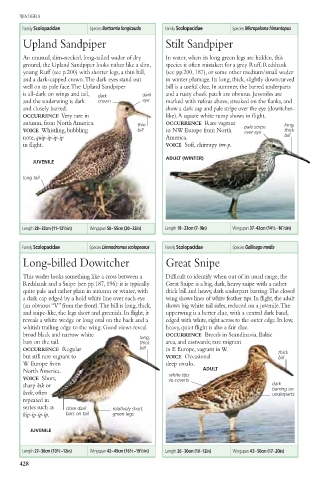
       An unusual, slim-necked, long-tailed wader of dry  In water, when its long green legs are hidden, this
       ground, the Upland Sandpiper looks rather like a slim,  species is often mistaken for a grey Ruff, Redshank
       young Ruff (see p.200) with shorter legs, a thin bill,  (see pp.200, 187), or some other medium/small wader
       and a dark-capped crown.The dark eyes stand out  in winter plumage. Its long, thick, slightly downcurved
       well on its pale face.The Upland Sandpiper   bill is a useful clue. In summer, the barred underparts
       is all-dark on wings and tail,  dark  dark  and a rusty cheek patch are obvious. Juveniles are
       and the underwing is dark  crown  eye  marked with rufous above, streaked on the flanks, and
       and closely barred.                show a dark cap and pale stripe over the eye (dowitcher-
       OCCURRENCE Very rare in            like).A square white rump shows in flight.
       autumn, from North America.  thin  OCCURRENCE Rare vagrant       long,
       VOICE Whistling, bubbling   bill   to NW Europe from North  pale stripe  thick
                                                              over eye
       note, quip-ip-ip-ip                America.                      bill
       in flight.                         VOICE Soft, chirrupy trrr-p.
                                          ADULT (WINTER)
         JUVENILE
       long tail


       Length 28–32cm (11–12 1 ⁄2in)  Wingspan 50–55cm (20–22in)  Length 18–23cm (7–9in)   Wingspan 37–42cm (14 1 ⁄2 –16 1 ⁄2in)

       Family Scolopacidae  Species Limnodromus scolopaceus  Family Scolopacidae  Species Gallinago media
       Long-billed Dowitcher              Great Snipe
       This wader looks something like a cross between a  Difficult to identify when out of its usual range, the
       Redshank and a Snipe (see pp.187, 196): it is typically  Great Snipe is a big, dark, heavy snipe with a rather
       quite pale and rather plain in autumn or winter, with  thick bill and heavy, dark underpart barring.The closed
       a dark cap edged by a bold white line over each eye  wing shows lines of white feather tips.In flight,the adult
       (an obvious “V” from the front).The bill is long, thick,  shows big white tail sides, reduced on a juvenile.The
       and snipe-like, the legs short and greenish. In flight, it  upperwing is a better clue, with a central dark band,
       reveals a white wedge or long oval on the back and a  edged with white,right across to the outer edge.Its low,
       whitish trailing edge to the wing. Good views reveal  heavy, quiet flight is also a fair clue.
       broad black and narrow white       OCCURRENCE Breeds in Scandinavia, Baltic
                                    long,
       bars on the tail.            thick  area, and eastwards; rare migrant
       OCCURRENCE Regular           bill  in E Europe, vagrant in W.
                                                                      thick
       but still rare vagrant to          VOICE Occasional            bill
       W Europe from                      deep croaks.
       North America.                              ADULT
                                           white tips
       VOICE Short,                        to coverts
       sharp kik or                                                  dark
                                                                     barring on
       keek, often                                                   underparts
       repeated in
       series such as  close dark  relatively short,
       kip-ip-ip-ip.  bars on tail  green legs
         JUVENILE
       Length 27–30cm (10 1 ⁄2 –12in)  Wingspan 42–49cm (16 1 ⁄2 –19 1 ⁄2in)  Length 26–30cm (10–12in)  Wingspan 43–50cm (17–20in)
      428

