


Page 429 - Complete Birds of Britain and Europe (DK - RSPB)
P. 429
WADERS
       Family Scolopacidae  Species Tringa flavipes  Family Scolopacidae  Species Tringa melanoleuca
       Lesser Yellowlegs                  Greater Yellowlegs
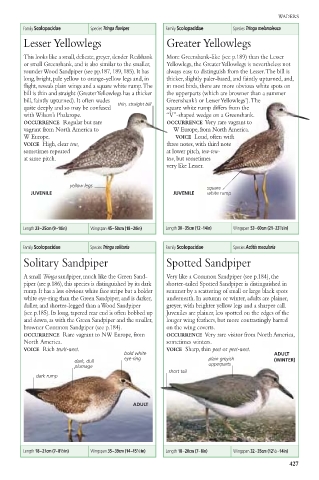
       This looks like a small,delicate,greyer,slender Redshank  More Greenshank-like (see p.189) than the Lesser
       or small Greenshank, and is also similar to the smaller,  Yellowlegs, the Greater Yellowlegs is nevertheless not
       rounder Wood Sandpiper (see pp.187,189,185).It has  always easy to distinguish from the Lesser.The bill is
       long,bright,pale yellow to orange-yellow legs and, in  thicker, slightly paler-based, and faintly upturned, and,
       flight, reveals plain wings and a square white rump.The  in most birds, there are more obvious white spots on
       bill is thin and straight (Greater Yellowlegs has a thicker  the upperparts (which are browner than a summer
       bill, faintly upturned). It often wades  Greenshank’s or Lesser Yellowlegs’).The
       quite deeply and so may be confused  thin, straight bill  square white rump differs from the
       with Wilson’s Phalarope.           “V”-shaped wedge on a Greenshank.
       OCCURRENCE Regular but rare        OCCURRENCE Very rare vagrant to
       vagrant from North America to        W Europe,from North America.
       W Europe.                             VOICE Loud, often with
       VOICE High, clear tew,             three notes, with third note
       sometimes repeated                 at lower pitch, tew-tew-
       at same pitch.                     tew, but sometimes
                                          very like Lesser.

                  yellow legs
                                                    square
         JUVENILE                           JUVENILE  white rump


       Length 23–25cm (9–10in)   Wingspan 45–50cm (18–20in)  Length 30–35cm (12–14in)   Wingspan 53–60cm (21–23 1 ⁄2in)

       Family Scolopacidae  Species Tringa solitaria  Family Scolopacidae  Species Actitis macularia
       Solitary Sandpiper                 Spotted Sandpiper
       A small Tringa sandpiper, much like the Green Sand-  Very like a Common Sandpiper (see p.184), the
       piper (see p.186),this species is distinguished by its dark  shorter-tailed Spotted Sandpiper is distinguished in
       rump.It has a less obvious white face stripe but a bolder  summer by a scattering of small or large black spots
       white eye-ring than the Green Sandpiper,and is darker,  underneath. In autumn or winter, adults are plainer,
       duller, and shorter-legged than a Wood Sandpiper   greyer, with brighter yellow legs and a sharper call.
       (see p.185).Its long,tapered rear end is often bobbed up  Juveniles are plainer, less spotted on the edges of the
       and down,as with the Green Sandpiper and the smaller,  longer wing feathers, but more contrastingly barred
       browner Common Sandpiper (see p.184).  on the wing coverts.
       OCCURRENCE Rare vagrant to NW Europe, from  OCCURRENCE Very rare visitor from North America,
       North America.                     sometimes winters.
       VOICE Rich tewit-weet.             VOICE Sharp, thin peet or peet-weet.
                                bold white                           ADULT
                                eye-ring             plain greyish
                    dark, dull                                       (WINTER)
                    plumage                          upperparts
                                           short tail
          dark rump
                                  ADULT


       Length 18–21cm (7–8 1 ⁄2in)  Wingspan 35–39cm (14–15 1 ⁄2in)  Length 18–20cm (7–8in)  Wingspan 32–35cm (12 1 ⁄2 –14in)
                                                                         427

