


Page 428 - Complete Birds of Britain and Europe (DK - RSPB)
P. 428
WADERS
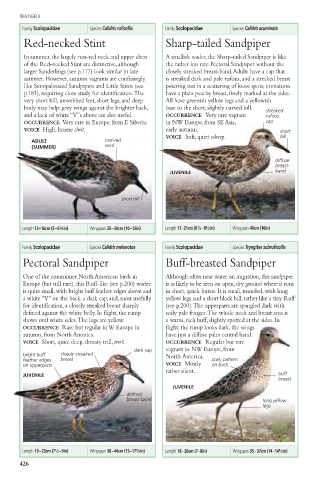
       Family Scolopacidae  Species Calidris ruficollis  Family Scolopacidae  Species Calidris acuminata
       Red-necked Stint                   Sharp-tailed Sandpiper
       In summer, the largely rust-red neck and upper chest  A smallish wader, the Sharp-tailed Sandpiper is like
       of the Red-necked Stint are distinctive, although  the rather less rare Pectoral Sandpiper without the
       larger Sanderlings (see p.177) look similar in late  closely streaked breast-band.Adults have a cap that
       summer. However, autumn vagrants are confusingly  is streaked dark and pale rufous, and a streaked breast
       like Semipalmated Sandpipers and Little Stints (see  petering out in a scattering of loose spots; immatures
       p.181), requiring close study for identification.The  have a plain peachy breast, finely marked at the sides.
       very short bill, unwebbed feet, short legs, and deep  All have greenish yellow legs and a yellowish
       body may help; grey wings against the brighter back,  base to the short, slightly curved bill.  streaked
       and a lack of white “V”s above are also useful.  OCCURRENCE Very rare vagrant   rufous
       OCCURRENCE Very rare in Europe, from E Siberia.  in NW Europe, from SE Asia,  cap
       VOICE High, hoarse chrit.          early autumn.                short
                                          VOICE Soft, quiet wheep.     bill
         ADULT             rust-red
         (SUMMER)          neck
                                                                     diffuse
                                                                     breast-
                                           JUVENILE                  band


                               short bill


       Length 13–16cm (5–6 1 ⁄2in)  Wingspan 25–30cm (10–12in)  Length 17–21cm (6 1 ⁄2–8 1 ⁄2in)   Wingspan 40cm (16in)

       Family Scolopacidae  Species Calidris melanotos  Family Scolopacidae  Species Tryngites subruficollis
       Pectoral Sandpiper                 Buff-breasted Sandpiper
       One of the commoner North American birds in  Although often near water on migration,this sandpiper
       Europe (but still rare), this Ruff-like (see p.200) wader  is as likely to be seen on open,dry ground where it runs
       is quite small, with bright buff feather edges above and  in short, quick bursts. It is small, rounded, with long
       a white “V” on the back, a dark cap, and, most usefully  yellow legs and a short black bill, rather like a tiny Ruff
       for identification, a closely streaked breast sharply  (see p.200).The upperparts are spangled dark with
       defined against the white belly. In flight, the rump  scaly pale fringes.The whole neck and breast area is
       shows oval white sides.The legs are yellow.  a warm, rich buff, slightly spotted at the sides. In
       OCCURRENCE Rare but regular in W Europe in  flight, the rump looks dark, the wings
       autumn, from North America.        have just a diffuse paler central band.
       VOICE Short, quite deep, throaty trill, trrr’t.  OCCURRENCE Regular but rare
                                  dark cap  vagrant to NW Europe, from
       bright buff  closely streaked      North America.
       feather edges  breast                          scaly pattern
       on upperparts                      VOICE Mostly  on back
                                          rather silent.
       JUVENILE                                                       buff
                                                                      breast
                                            JUVENILE
                                defined
                                breast-band                       long yellow
                                                                  legs


       Length 19–23cm (7 1 ⁄2–9in)   Wingspan 38–44cm (15–17 1 ⁄2in)  Length 18–20cm (7–8in)   Wingspan 35–37cm (14–14 1 ⁄2in)
      426

