


Page 431 - Complete Birds of Britain and Europe (DK - RSPB)
P. 431
WADERS/SKUAS, GULLS,AND TERNS
       Family Scolopacidae  Species Phalaropus tricolor  Family Laridae  Species Larus genei
       Wilson’s Phalarope                 Slender-billed Gull
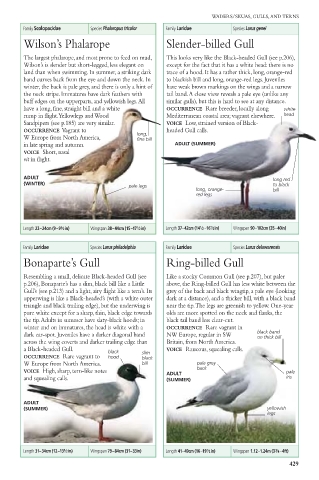
       The largest phalarope, and most prone to feed on mud,  This looks very like the Black-headed Gull (see p.206),
       Wilson’s is slender but short-legged, less elegant on  except for the fact that it has a white head: there is no
       land than when swimming. In summer, a striking dark  trace of a hood. It has a rather thick, long, orange-red
       band curves back from the eye and down the neck. In  to blackish bill and long, orange-red legs. Juveniles
       winter, the back is pale grey, and there is only a hint of  have weak brown markings on the wings and a narrow
       the neck stripe. Immatures have dark feathers with  tail band.A close view reveals a pale eye (unlike any
       buff edges on the upperparts, and yellowish legs.All  similar gulls), but this is hard to see at any distance.
       have a long, fine, straight bill and a white  OCCURRENCE Rare breeder, locally along  white
       rump in flight.Yellowlegs and Wood  Mediterranean coastal area; vagrant elsewhere.  head
       Sandpipers (see p.185) are very similar.  VOICE Low, strained version of Black-
       OCCURRENCE Vagrant to       long,  headed Gull calls.
       W Europe from North America,  fine bill
       in late spring and autumn.           ADULT (SUMMER)
       VOICE Short, nasal
       vit in flight.

       ADULT                                                         long red
       (WINTER)                  pale legs                           to black
                                                  long, orange-      bill
                                                  red legs


       Length 22–24cm (9–9 1 ⁄2in)  Wingspan 38–44cm (15–17 1 ⁄2in)  Length 37–42cm (14 1 ⁄2 –16 1 ⁄2in)  Wingspan 90–102cm (35–40in)

       Family Laridae  Species Larus philadelphia  Family Laridae  Species Larus delawarensis
       Bonaparte’s Gull                   Ring-billed Gull
       Resembling a small, delicate Black-headed Gull (see  Like a stocky Common Gull (see p.207), but paler
       p.206), Bonaparte’s has a slim, black bill like a Little  above, the Ring-billed Gull has less white between the
       Gull’s (see p.213) and a light, airy flight like a tern’s. Its  grey of the back and black wingtip, a pale eye (looking
       upperwing is like a Black-headed’s (with a white outer  dark at a distance), and a thicker bill, with a black band
       triangle and black trailing edge), but the underwing is  near the tip.The legs are greenish to yellow. One-year
       pure white except for a sharp, thin, black edge towards  olds are more spotted on the neck and flanks, the
       the tip.Adults in summer have slaty-black hoods; in  black tail band less clear-cut.
       winter and on immatures, the head is white with a  OCCURRENCE Rare vagrant in
                                                                 black band
       dark ear-spot. Juveniles have a darker diagonal band  NW Europe, regular in SW
                                                                 on thick bill
       across the wing coverts and darker trailing edge than   Britain, from North America.
       a Black-headed Gull.               VOICE Raucous, squealing calls.
                            black   slim
       OCCURRENCE Rare vagrant to   hood  black
       W Europe from North America.  bill         pale grey
                                                  back
       VOICE High, sharp, tern-like notes                               pale
                                          ADULT
       and squealing calls.               (SUMMER)                      iris
       ADULT
       (SUMMER)                                                    yellowish
                                                                   legs


       Length 31–34cm (12–13 1 ⁄2in)  Wingspan 79–84cm (31–33in)  Length 41–49cm (16–19 1 ⁄2in)   Wingspan 1.12–1.24m (3 3 ⁄4 –4ft)
                                                                         429

