


Page 432 - Complete Birds of Britain and Europe (DK - RSPB)
P. 432
SKUAS, GULLS,AND TERNS
       Family Laridae  Species Larus audouinii  Family Laridae  Species Larus ichthyaetus
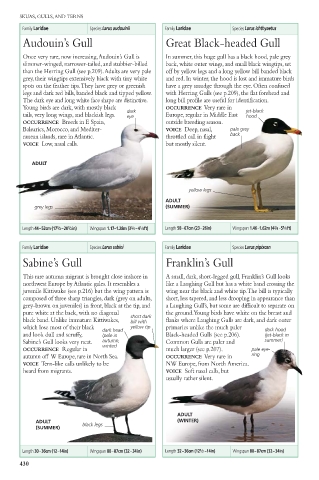
       Audouin’s Gull                     Great Black-headed Gull
       Once very rare, now increasing,Audouin’s Gull is  In summer, this huge gull has a black hood, pale grey
       slimmer-winged, narrower-tailed, and stubbier-billed  back, white outer wings, and small black wingtips, set
       than the Herring Gull (see p.209).Adults are very pale  off by yellow legs and a long yellow bill banded black
       grey, their wingtips extensively black with tiny white  and red. In winter, the hood is lost and immature birds
       spots on the feather tips.They have grey or greenish  have a grey smudge through the eye. Often confused
       legs and dark red bills, banded black and tipped yellow.  with Herring Gulls (see p.209), the flat forehead and
       The dark eye and long white face shape are distinctive.  long bill profile are useful for identification.
       Young birds are dark, with mostly black  dark  OCCURRENCE Very rare in  jet-black
       tails, very long wings, and blackish legs.  eye  Europe, regular in Middle East  hood
       OCCURRENCE Breeds in E Spain,      outside breeding season.
       Balearics, Morocco, and Mediter-   VOICE Deep, nasal,  pale grey
       ranean islands, rare in Atlantic.  throttled call in flight  back
       VOICE Low, nasal calls.            but mostly silent.

         ADULT


                                                yellow legs
                                          ADULT
          grey legs                       (SUMMER)

       Length 44–52cm (17 1 ⁄2 –20 1 ⁄2in)  Wingspan 1.17–1.28m (3 3 ⁄4 –4 1 ⁄4ft)  Length 58–67cm (23–26in)  Wingspan 1.46–1.62m (4 3 ⁄4 –5 1 ⁄4ft)

       Family Laridae  Species Larus sabini  Family Laridae  Species Larus pipixcan
       Sabine’s Gull                      Franklin’s Gull
       This rare autumn migrant is brought close inshore in  A small, dark, short-legged gull, Franklin’s Gull looks
       northwest Europe by Atlantic gales. It resembles a  like a Laughing Gull but has a white band crossing the
       juvenile Kittiwake (see p.216) but the wing pattern is  wing near the black and white tip.The bill is typically
       composed of three sharp triangles, dark (grey on adults,  short, less tapered, and less drooping in appearance than
       grey-brown on juveniles) in front, black at the tip, and  a Laughing Gull’s, but some are difficult to separate on
       pure white at the back, with no diagonal  the ground.Young birds have white on the breast and
                                 short dark
       black band. Unlike immature Kittiwakes,  bill with  flanks where Laughing Gulls are dark, and dark outer
       which lose most of their black  yellow tip  primaries unlike the much paler
                          dark head                                dark hood
       and look dull and scruffy,  (pale in  Black-headed Gulls (see p.206).  (jet-black in
       Sabine’s Gull looks very neat.  autumn,  Common Gulls are paler and  summer)
                          winter)
       OCCURRENCE Regular in              much larger (see p.207).  pale eye-
       autumn off  W Europe,rare in North Sea.  OCCURRENCE Very rare in   ring
       VOICE Tern-like calls unlikely to be  NW Europe, from North America.
       heard from migrants.               VOICE Soft nasal calls, but
                                          usually rather silent.


                                             ADULT
          ADULT      black legs              (WINTER)
          (SUMMER)


       Length 30–36cm (12–14in)  Wingspan 80–87cm (32–34in)  Length 32–36cm (12 1 ⁄2 –14in)  Wingspan 80–87cm (32–34in)
      430

