


Page 433 - Complete Birds of Britain and Europe (DK - RSPB)
P. 433
SKUAS, GULLS,AND TERNS
       Family Laridae  Species Larus atricilla  Family Laridae  Species Pagophila eburnea
       Laughing Gull                      Ivory Gull
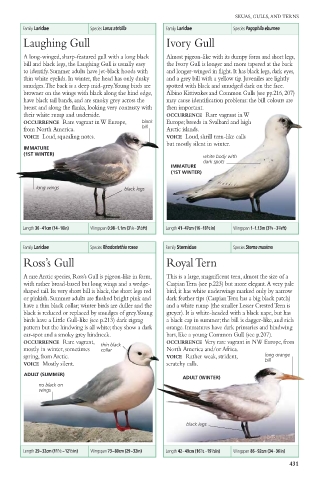
       A long-winged, sharp-featured gull with a long black  Almost pigeon-like with its dumpy form and short legs,
       bill and black legs, the Laughing Gull is usually easy   the Ivory Gull is longer and more tapered at the back
       to identify. Summer adults have jet-black hoods with  and longer-winged in flight.It has black legs,dark eyes,
       thin white eyelids. In winter, the head has only dusky  and a grey bill with a yellow tip. Juveniles are lightly
       smudges.The back is a deep mid-grey.Young birds are  spotted with black and smudged dark on the face.
       browner on the wings with black along the hind edge,  Albino Kittiwakes and Common Gulls (see pp.216,207)
       have black tail bands, and are smoky grey across the  may cause identification problems: the bill colours are
       breast and along the flanks, looking very contrasty with  then important.
       their white rump and underside.    OCCURRENCE Rare vagrant in W
       OCCURRENCE Rare vagrant in W Europe,  black  Europe; breeds in Svalbard and high
       from North America.          bill  Arctic islands.
       VOICE Loud, squealing notes.       VOICE Loud, shrill tern-like calls
                                          but mostly silent in winter.
       IMMATURE
       (1ST WINTER)
                                                   white body with
                                                   dark spots
                                           IMMATURE
                                           (1ST WINTER)
          long wings            black legs


       Length 36–41cm (14–16in)  Wingspan 0.98–1.1m (3 1 ⁄4 –3 1 ⁄2ft)  Length 41–47cm (16–18 1 ⁄2in)  Wingspan 1–1.13m (3 1 ⁄4 –3 3 ⁄4ft)

       Family Laridae  Species Rhodostethia rosea  Family Sternidae  Species Sterna maxima
       Ross’s Gull                        Royal Tern
       A rare Arctic species,Ross’s Gull is pigeon-like in form,  This is a large, magnificent tern, almost the size of a
       with rather broad-based but long wings and a wedge-  Caspian Tern (see p.223) but more elegant.A very pale
       shaped tail. Its very short bill is black, the short legs red  bird, it has white underwings marked only by narrow
       or pinkish. Summer adults are flushed bright pink and  dark feather tips (Caspian Tern has a big black patch)
       have a thin black collar; winter birds are duller and the  and a white rump (the smaller Lesser Crested Tern is
       black is reduced or replaced by smudges of grey.Young  greyer). It is white-headed with a black nape, but has
       birds have a Little Gull-like (see p.213) dark zigzag  a black cap in summer; the bill is dagger-like, and rich
       pattern but the hindwing is all white; they show a dark  orange. Immatures have dark primaries and hindwing
       ear-spot and a smoky grey hindneck.  bars, like a young Common Gull (see p.207).
       OCCURRENCE Rare vagrant,           OCCURRENCE Very rare vagrant in NW Europe,from
                          thin black
       mostly in winter, sometimes  collar  North America and/or Africa.
       spring, from Arctic.               VOICE Rather weak, strident,  long orange
                                                                   bill
       VOICE Mostly silent.               scratchy calls.
       ADULT (SUMMER)
                                              ADULT (WINTER)
           no black on
           wings

                                               black legs


       Length 29–32cm (11 1 ⁄2 –12 1 ⁄2in)  Wingspan 73–80cm (29–32in)  Length 42–49cm (16 1 ⁄2 –19 1 ⁄2in)  Wingspan 86–92cm (34–36in)
                                                                         431

