


Page 436 - Complete Birds of Britain and Europe (DK - RSPB)
P. 436
CUCKOOS/PARROTS/OWLS
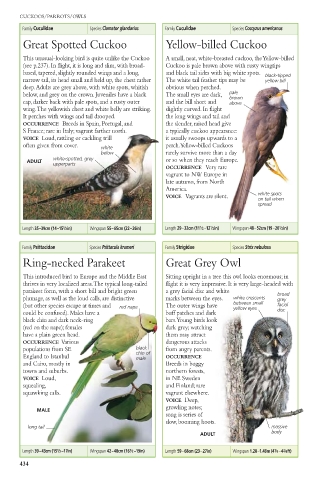
       Family Cuculidae  Species Clamator glandarius  Family Cuculidae  Species Coccyzus americanus
       Great Spotted Cuckoo               Yellow-billed Cuckoo

       This unusual-looking bird is quite unlike the Cuckoo  A small, neat, white-breasted cuckoo, the Yellow-billed
       (see p.237). In flight, it is long and slim, with broad-  Cuckoo is pale brown above with rusty wingtips
       based, tapered, slightly rounded wings and a long,  and black tail sides with big white spots.  black-tipped
       narrow tail, its head small and held up, the chest rather  The white tail feather tips may be  yellow bill
       deep.Adults are grey above, with white spots, whitish  obvious when perched.
       below, and grey on the crown. Juveniles have a black  The small eyes are dark,  pale
                                                          brown
       cap, darker back with pale spots, and a rusty outer  and the bill short and  above
       wing.The yellowish chest and white belly are striking.  slightly curved. In flight
       It perches with wings and tail drooped.  the long wings and tail and
       OCCURRENCE Breeds in Spain, Portugal, and   the slender, raised head give
       S France; rare in Italy; vagrant farther north.  a typically cuckoo appearance:
       VOICE Loud, rattling or cackling trill  it usually swoops upwards to a
       often given from cover.  white     perch.Yellow-billed Cuckoos
                          below           rarely survive more than a day
              white-spotted, grey
        ADULT                             or so when they reach Europe.
              upperparts
                                          OCCURRENCE Very rare
                                          vagrant to NW Europe in
                                          late autumn, from North
                                          America.
                                          VOICE Vagrants are silent.  white spots
                                                                 on tail when
                                                                 spread
       Length 35–39cm (14–15 1 ⁄2in)  Wingspan 55–65cm (22–26in)  Length 29–32cm (11 1 ⁄2 –12 1 ⁄2in)   Wingspan 48–52cm (19–20 1 ⁄2in)

       Family Psittacidae  Species Psittacula krameri  Family Strigidae  Species Strix nebulosa
       Ring-necked Parakeet               Great Grey Owl
       This introduced bird to Europe and the Middle East  Sitting upright in a tree this owl looks enormous; in
       thrives in very localized areas.The typical long-tailed  flight it is very impressive. It is very large-headed with
       parakeet form, with a short bill and bright green  a grey facial disc and white
                                                                      broad
       plumage, as well as the loud calls, are distinctive   marks between the eyes.  white crescents  grey
                                                           between small
       (but other species escape at times and  red nape  The outer wings have  yellow eyes  facial
       could be confused). Males have a   buff patches and dark       disc
       black chin and dark neck-ring      bars.Young birds look
       (red on the nape);females          dark grey; watching
       have a plain green head.           them may attract
       OCCURRENCE Various                 dangerous attacks
       populations from SE         black  from angry parents.
                                   chin of
       England to Istanbul         male   OCCURRENCE
       and Cairo, mostly in               Breeds in boggy
       towns and suburbs.                 northern forests,
       VOICE Loud,                        in NE Sweden
       squealing,                         and Finland; rare
       squawking calls.                   vagrant elsewhere.
                                          VOICE Deep,
                                          growling notes;
          MALE
                                          song is series of
                                          slow, booming hoots.
        long tail                                                   massive
                                                   ADULT            body
       Length 39–43cm (15 1 ⁄2 –17in)  Wingspan 42–48cm (16 1 ⁄2 –19in)  Length 59–68cm (23–27in)  Wingspan 1.28–1.48m (4 1 ⁄4 –4 3 ⁄4ft)
      434

