


Page 439 - Complete Birds of Britain and Europe (DK - RSPB)
P. 439
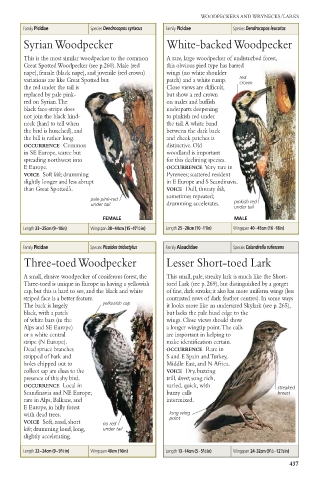
WOODPECKERS AND WRYNECKS/LARKS
       Family Picidae  Species Dendrocopos syriacus  Family Picidae  Species Dendrocopos leucotos
       Syrian Woodpecker                  White-backed Woodpecker

       This is the most similar woodpecker to the common  A rare, large woodpecker of undisturbed forest,
       Great Spotted Woodpecker (see p.260). Male (red  this obvious pied type has barred
       nape), female (black nape), and juvenile (red crown)  wings (no white shoulder
       variations are like Great Spotted but  patch) and a white rump.  red
                                                            crown
       the red under the tail is          Close views are difficult,
       replaced by pale pink-             but show a red crown
       red on Syrian.The                  on males and buffish
       black face-stripe does             underparts deepening
       not join the black hind-           to pinkish red under
       neck (hard to tell when            the tail.A white band
       the bird is hunched), and          between the dark back
       the bill is rather long.           and cheek patches is
       OCCURRENCE Common                  distinctive. Old
       in SE Europe, scarce but           woodland is important
       spreading northwest into           for this declining species.
       E Europe.                          OCCURRENCE Very rare in
       VOICE Soft kik; drumming           Pyrenees; scattered resident
       slightly longer and less abrupt    in E Europe and S Scandinavia.
       than Great Spotted’s.              VOICE Dull, throaty kik,
                                          sometimes repeated;
                        pale pink-red                      pinkish red
                        under tail        drumming accelerates.
                                                           under tail
                           FEMALE                          MALE
       Length 23–25cm (9–10in)  Wingspan 38–44cm (15–17 1 ⁄2in)  Length 25–28cm (10–11in)  Wingspan 40–45cm (16–18in)

       Family Picidae  Species Picoides tridactylus  Family Alaudidae  Species Calandrella rufescens
       Three-toed Woodpecker              Lesser Short-toed Lark
       A small, elusive woodpecker of coniferous forest, the  This small, pale, streaky lark is much like the Short-
       Three-toed is unique in Europe in having a yellowish  toed Lark (see p. 269), but distinguished by a gorget
       cap, but this is hard to see, and the black and white  of fine, dark streaks;it also has more uniform wings (less
       striped face is a better feature.  contrasted rows of dark feather centres). In some ways
                           yellowish cap
       The back is largely                it looks more like an undersized Skylark (see p. 265),
       black, with a patch                but lacks the pale hind edge to the
       of white bars (in the              wings. Close views should show
       Alps and SE Europe)                a longer wingtip point.The calls
       or a white central                 are important in helping to
       stripe (N Europe).                 make identification certain.
       Dead spruce branches               OCCURRENCE Rare in
       stripped of bark and               S and E Spain and Turkey,
       holes chipped out to               Middle East, and N Africa.
       collect sap are clues to the       VOICE Dry, buzzing
       presence of this shy bird.         trill, drrrrt; song rich,
       OCCURRENCE Local in                varied, quick, with         streaked
       Scandinavia and NE Europe;         buzzy calls                 breast
       rare in Alps, Balkans, and         intermixed.
       E Europe, in hilly forest
       with dead trees.                    long wing
                                           point
       VOICE Soft, nasal, short  no red
       kik; drumming loud, long,  under tail
       slightly accelerating.
       Length 22–24cm (9–9 1 ⁄2in)  Wingspan 40cm (16in)  Length 13–14cm (5–5 1 ⁄2in)  Wingspan 24–32cm (9 1 ⁄2 –12 1 ⁄2in)
                                                                         437

