


Page 438 - Complete Birds of Britain and Europe (DK - RSPB)
P. 438
NIGHTJARS/SWIFTS/WOODPECKERS AND WRYNECKS
       Family Caprimulgidae  Species Caprimulgus ruficollis  Family Apodidae  Species Apus caffer
       Red-necked Nightjar                White-rumped Swift

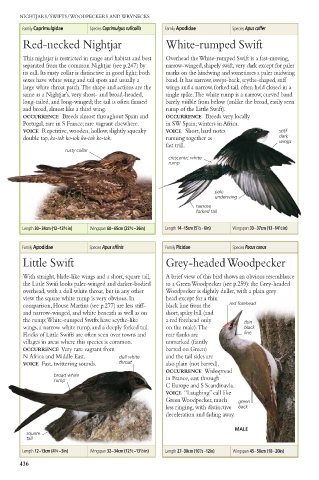
       This nightjar is restricted in range and habitat and best  Overhead the White-rumped Swift is a fast-moving,
       separated from the common Nightjar (see p.247) by  narrow-winged,shapely swift,very dark except for paler
       its call. Its rusty collar is distinctive in good light; both  marks on the hindwing and sometimes a paler midwing
       sexes have white wing and tail spots and usually a  band. It has narrow, swept-back, scythe-shaped, stiff
       large white throat patch.The shape and actions are the  wings and a narrow, forked tail, often held closed in a
       same as a Nightjar’s, very short- and broad-headed,  single spike.The white rump is a narrow, curved band
       long-tailed, and long-winged; the tail is often fanned  barely visible from below (unlike the broad, easily seen
       and broad, almost like a third wing.  rump of the Little Swift).
       OCCURRENCE Breeds almost throughout Spain and  OCCURRENCE Breeds very locally
       Portugal, rare in S France; rare vagrant elsewhere.  in SW Spain; winters in Africa.
       VOICE Repetitive, wooden, hollow, slightly squeaky  VOICE Short, hard notes  stiff
       double tap, ko-tok ko-tok ko-tok ko-tok.  running together as  dark
                                                                      wings
                                          fast trill.
                 rusty collar
                                           crescentic white
                                           rump

                                                      pale
                                                      underwing
                                                  narrow,
                                                  forked tail
       Length 30–34cm (12–13 1 ⁄2in)  Wingspan 60–65cm (23 1 ⁄2 –26in)  Length 14–15cm (5 1 ⁄2 –6in)  Wingspan 33–37cm (13–14 1 ⁄2in)

       Family Apodidae  Species Apus affinis  Family Picidae  Species Pacus canus
       Little Swift                       Grey-headed Woodpecker
       With straight, blade-like wings and a short, square tail,  A brief view of this bird shows an obvious resemblance
       the Little Swift looks paler-winged and darker-bodied  to a GreenWoodpecker (see p.259): the Grey-headed
       overhead, with a dull white throat, but in any other  Woodpecker is slightly duller, with a plain grey
       view the square white rump is very obvious. In  head except for a thin
       comparison, House Martins (see p.277) are less stiff-  black line from the  red forehead
       and narrow-winged, and white beneath as well as on  short, spiky bill (and
       the rump;White-rumped Swifts have scythe-like  a red forehead only   thin
       wings, a narrow white rump, and a deeply forked tail.  on the male).The  black
       Flocks of Little Swifts are often seen over towns and  rear flanks are  line
       villages in areas where this species is common.  unmarked (faintly
       OCCURRENCE Very rare vagrant from   barred on Green)
       N Africa and Middle East.  dull white  and the tail sides are
       VOICE Fast, twittering sounds.  throat  also plain (not barred).
                                          OCCURRENCE Widespread
              broad white
              rump                        in France, east through
                                          C Europe and S Scandinavia.
                                          VOICE “Laughing” call like
                                          Green Woodpecker, much  green
                                          less ringing, with distinctive  back
                                          deceleration and fading away.
                                                           MALE
        square
        tail
       Length 12–13cm (4 3 ⁄4 –5in)  Wingspan 32–34cm (12 1 ⁄2 –13 1 ⁄2in)  Length 27–30cm (10 1 ⁄2 –12in)  Wingspan 45–50cm (18–20in)
      436

