


Page 441 - Complete Birds of Britain and Europe (DK - RSPB)
P. 441
PIPITS AND WAGTAILS/THRUSHES
       Family Motacillidae  Species Anthus gustavi  Family Motacillidae  Species Motacilla citreola
       Pechora Pipit                      Citrine Wagtail
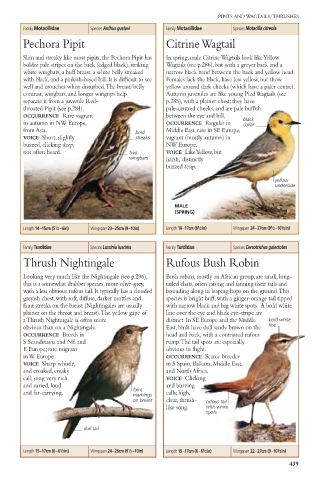
       Slim and streaky like most pipits, the Pechora Pipit has  In spring, male Citrine Wagtails look like Yellow
       bolder pale stripes on the back (edged black), striking  Wagtails (see p.286), but with a greyer back and a
       white wingbars, a buff breast, a white belly streaked  narrow black band between the back and yellow head.
       with black, and a pinkish-based bill. It is difficult to see  Females lack the black, have less yellow, but show
       well and crouches when disturbed.The breast/belly  yellow around dark cheeks (which have a paler centre).
       contrast, wingbars, and longer wingtips help  Autumn juveniles are like young Pied Wagtails (see
       separate it from a juvenile Red-   p.285), with a plainer chest; they have
       throated Pipit (see p.284).        pale-centred cheeks, and are pale buffish
       OCCURRENCE Rare vagrant            between the eye and bill.  black
       in autumn in NW Europe,            OCCURRENCE Regular in  collar
       from Asia.                  bold   Middle East, rare in SE Europe,
       VOICE Short, slightly       streaks  vagrant (mostly autumn) in
       buzzed, clicking dzep,             NW Europe.
       not often heard.          two      VOICE Like Yellow, but
                                 wingbars  harsh, distinctly
                                          buzzed tzsip.

                                                                     yellow
                                                                     underside

                                            MALE
                                            (SPRING)
       Length 14–15cm (5 1 ⁄2 –6in)   Wingspan 23–25cm (9–10in)  Length 16–17cm (6 1 ⁄2in)  Wingspan 24–27cm (9 1 ⁄2 –10 1 ⁄2in)

       Family Turdidae  Species Luscinia luscinia  Family Turdidae  Species Cercotrichas galactotes
       Thrush Nightingale                 Rufous Bush Robin
       Looking very much like the Nightingale (see p.296),  Bush robins, mostly an African group, are small, long-
       this is a somewhat drabber species, more olive-grey,  tailed chats, often raising and fanning their tails and
       with a less obvious rufous tail. It typically has a clouded  bounding along in leaping hops on the ground.This
       greyish chest, with soft, diffuse, darker mottles and  species is bright buff, with a ginger-orange tail tipped
       faint streaks on the breast (Nightingales are usually  with narrow black and big white spots. A bold white
       plainer on the throat and breast).The yellow gape of   line over the eye and black eye-stripe are
       a Thrush Nightingale is often more  distinct. In SE Europe and the Middle  bold white
                                                                    line
       obvious than on a Nightingale.     East, birds have dull sandy brown on the
       OCCURRENCE Breeds in               head and back, with a contrasted rufous
       S Scandinavia and NE and           rump.The tail spots are especially
       E Europe; rare migrant             obvious in flight.
       in W Europe.                       OCCURRENCE Scarce breeder
       VOICE Sharp whistle,               in S Spain, Balkans, Middle East,
       and croaked, creaky                and North Africa.
       call; song very rich               VOICE Clicking
       and varied, loud                   and buzzing
                                  faint
       and far-carrying.                  calls; high,
                                  markings
                                  on breast  clear, thrush-  rufous tail
                                          like song.  with white
                                                    spots
                      dull tail


       Length 15–17cm (6–6 1 ⁄2in)   Wingspan 24–26cm (9 1 ⁄2 –10in)  Length 15–17cm (6–6 1 ⁄2in)  Wingspan 22–27cm (9–10 1 ⁄2in)
                                                                         439

