


Page 440 - Complete Birds of Britain and Europe (DK - RSPB)
P. 440
LARKS/PIPITS AND WAGTAILS
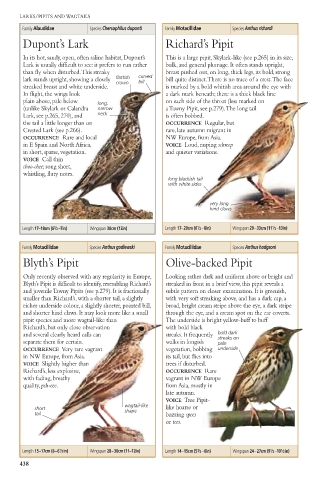
       Family Alaudidae  Species Chersophilus duponti  Family Motacillidae  Species Anthus richardi
       Dupont’s Lark                      Richard’s Pipit
       In its hot, sandy, open, often saline habitat, Dupont’s  This is a large pipit, Skylark-like (see p.265) in its size,
       Lark is usually difficult to see: it prefers to run rather  bulk, and general plumage. It often stands upright,
       than fly when disturbed.This streaky  breast pushed out, on long, thick legs, its bold, strong
       lark stands upright, showing a closely  flattish  curved  bill quite distinct.There is no trace of a crest.The face
                                   bill
                              crown
       streaked breast and white underside.  is marked by a bold whitish area around the eye with
       In flight, the wings look          a dark mark beneath; there is a thick black line
       plain above, pale below  long,     on each side of the throat (less marked on
       (unlike Skylark or Calandra  narrow  a Tawny Pipit, see p.279).The long tail
       Lark, see p.265, 270), and  neck              is often bobbed.
       the tail a little longer than on   OCCURRENCE Regular, but
       Crested Lark (see p.266).          rare, late autumn migrant in
       OCCURRENCE Rare and local          NW Europe, from Asia.
       in E Spain and North Africa,       VOICE Loud, rasping schreep
       in short, sparse, vegetation.      and quieter variations.
       VOICE Call thin
       choo-chee; song short,
       whistling, fluty notes.
                                           long blackish tail
                                           with white sides
                                                     very long
                                                     hind claws

       Length 17–18cm (6 1 ⁄2 –7in)  Wingspan 30cm (12in)  Length 17–20cm (6 1 ⁄2 –8in)  Wingspan 29–33cm (11 1 ⁄2 –13in)

       Family Motacillidae  Species Anthus godlewski  Family Motacillidae  Species Anthus hodgsoni
       Blyth’s Pipit                      Olive-backed Pipit
       Only recently observed with any regularity in Europe,  Looking rather dark and uniform above or bright and
       Blyth’s Pipit is difficult to identify,resembling Richard’s  streaked in front in a brief view, this pipit reveals a
       and juvenile Tawny Pipits (see p.279). It is fractionally  subtle pattern on closer examination. It is greenish,
       smaller than Richard’s, with a shorter tail, a slightly  with very soft streaking above, and has a dark cap, a
       richer underside colour, a slightly shorter, pointed bill,  broad, bright cream stripe above the eye, a dark stripe
       and shorter hind claws. It may look more like a small  through the eye, and a cream spot on the ear coverts.
       pipit species and more wagtail-like than  The underside is bright yellow-buff to buff
       Richard’s, but only close observation  with bold black
       and several clearly heard calls can  streaks. It frequently  bold dark
                                                       streaks on
       separate them for certain.         walks in longish  pale
       OCCURRENCE Very rare vagrant       vegetation, bobbing  underside
       in NW Europe, from Asia.           its tail, but flies into
       VOICE Slightly higher than         trees if disturbed.
       Richard’s, less explosive,         OCCURRENCE Rare
       with fading, breathy               vagrant in NW Europe
       quality, psh-eee.                  from Asia, mostly in
                                          late autumn.
                                          VOICE Tree Pipit-
                                wagtail-like
          short                 shape     like hoarse or
          tail                            buzzing spees
                                          or tees.


       Length 15–17cm (6–6 1 ⁄2in)   Wingspan 28–30cm (11–12in)  Length 14–15cm (5 1 ⁄2 –6in)   Wingspan 24–27cm (9 1 ⁄2 –10 1 ⁄2in)
      438

