


Page 84 - Complete Birds of Britain and Europe (DK - RSPB)
P. 84
BITTERNS AND HERONS
       Order Ciconiiformes    Family Ardeidae        Species Ardea cinerea
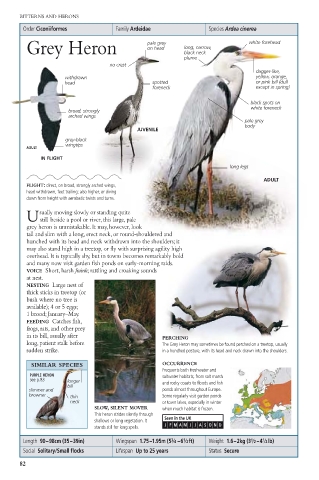
        Grey Heron                    pale grey  long, narrow,  white forehead
                                      on head
                                               black neck
                                               plume
                            no crest
                                                                 dagger-like,
                 withdrawn                                       yellow, orange,
                 head                  spotted                   or pink bill (dull
                                       foreneck                  except in spring)
                                                               black spots on
                                                               white foreneck
                  broad, strongly
                  arched wings
                                                              pale grey
                                                              body
                                   JUVENILE
                 grey-black
                 wingtips
        ADULT
           IN FLIGHT
                                                          long legs
                                                                  ADULT
        FLIGHT: direct, on broad, strongly arched wings,
        head withdrawn, feet trailing; also higher, or diving
        down from height with aerobatic twists and turns.
           sually moving slowly or standing quite
        U still beside a pool or river, this large, pale
        grey heron is unmistakable. It may, however, look
        tall and slim with a long, erect neck, or round-shouldered and
        hunched with its head and neck withdrawn into the shoulders; it
        may also stand high in a treetop, or fly with surprising agility high
        overhead. It is typically shy, but in towns becomes remarkably bold
        and many now visit garden fish ponds on early-morning raids.
        VOICE Short, harsh fraink; rattling and croaking sounds
        at nest.
        NESTING Large nest of
        thick sticks in treetop (or
        bush where no tree is
        available); 4 or 5 eggs;
        1 brood; January–May.
        FEEDING Catches fish,
        frogs, rats, and other prey
        in its bill, usually after       PERCHING
        long, patient stalk before       The Grey Heron may sometimes be found perched on a treetop, usually
        sudden strike.                   in a hunched posture, with its head and neck drawn into the shoulders.
         SIMILAR SPECIES                 OCCURRENCE
                                         Frequents both freshwater and
        PURPLE HERON                     saltwater habitats, from salt marsh
        see p.83  longer                 and rocky coasts to floods and fish
                  bill
        slimmer and                      ponds almost throughout Europe.
        browner   thin                   Some regularly visit garden ponds
                  neck                   or town lakes, especially in winter
                        SLOW, SILENT MOVER  when much habitat is frozen.
                        This heron strides silently through
                                          Seen in the UK
                        shallows or long vegetation. It
                                          J  F  M  A  M  JJ A S O  N  D
                        stands still for long spells.
       Length  90–98cm (35–39in)  Wingspan  1.75–1.95m (5 3 ⁄4 –6 1 ⁄2ft)  Weight  1.6–2kg (3 1 ⁄2 –4 1 ⁄2lb)
       Social  Solitary/Small flocks  Lifespan  Up to 25 years  Status  Secure
      82

