


Page 87 - Complete Birds of Britain and Europe (DK - RSPB)
P. 87
STORKS
       Order Ciconiiformes    Family Ciconiidae      Species Ciconia ciconia
        White Stork                             long red bill
                                                (dark grey on
                                                juvenile)

                     broad, fingered                           flat wings when
                     wings                                     gliding
                       outstretched
                       head
                              white body,
                              often soiled
                                                 black rear
                                                 wings
                     ADULT
            IN FLIGHT
                                                    trailing  ADULT
                                                    legs
                    ADULT


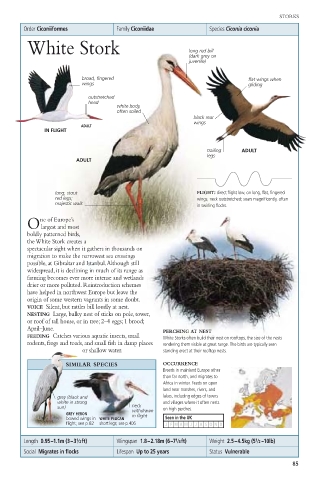
               long, stout                        FLIGHT: direct flight low, on long, flat, fingered
               red legs;                          wings, neck outstretched; soars magnificently, often
               majestic walk
                                                  in swirling flocks.
           ne of Europe’s
        O largest and most
        boldly patterned birds,
        the White Stork creates a
        spectacular sight when it gathers in thousands on
        migration to make the narrowest sea crossings
        possible, at Gibraltar and Istanbul.Although still
        widespread, it is declining in much of its range as
        farming becomes ever more intense and wetlands
        drier or more polluted. Reintroduction schemes
        have helped in northwest Europe but leave the
        origin of some western vagrants in some doubt.
        VOICE Silent, but rattles bill loudly at nest.
        NESTING Large, bulky nest of sticks on pole, tower,
        or roof of tall house, or in tree; 2–4 eggs; 1 brood;
        April–June.                       PERCHING AT NEST
        FEEDING Catches various aquatic insects, small  White Storks often build their nest on rooftops, the size of the nests
        rodents, frogs and toads, and small fish in damp places  rendering them visible at great range. The birds are typically seen
                     or shallow water.    standing erect at their rooftop nests.
                 SIMILAR SPECIES          OCCURRENCE
                                          Breeds in mainland Europe other
                                          than far north, and migrates to
                                          Africa in winter. Feeds on open
                                          land near marshes, rivers, and
               grey (black and            lakes, including edges of towns
               white in strong            and villages where it often nests
               sun)               neck    on high perches.
                                  withdrawn
                 GREY HERON       in flight
                 bowed wings in  WHITE PELICAN  Seen in the UK
                 flight; see p.82  short legs; see p.406  JF M A  M J  JA S ON D
       Length  0.95–1.1m (3–3 1 ⁄2ft)  Wingspan  1.8–2.18m (6–7 1 ⁄4ft)  Weight  2.5–4.5kg (5 1 ⁄2 –10lb)
       Social  Migrates in flocks  Lifespan  Up to 25 years  Status  Vulnerable
                                                                          85

