


Page 90 - Complete Birds of Britain and Europe (DK - RSPB)
P. 90
FLAMINGOS
       Order Phoenicopteriformes  Family Phoenicopteridae  Species Phoenicopterus ruber
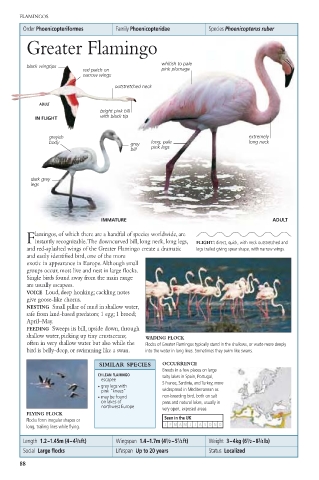
        Greater Flamingo


                                         whitish to pale
        black wingtips
                      red patch on       pink plumage
                      narrow wings
                              outstretched neck
           ADULT
                          bright pink bill
          IN FLIGHT       with black tip

             greyish                                           extremely
             body                grey  long, pale              long neck
                                 bill  pink legs


         dark grey
         legs


                          IMMATURE                                   ADULT
          lamingos, of which there are a handful of species worldwide, are
        Finstantly recognizable.The downcurved bill, long neck, long legs,  FLIGHT: direct, quick, with neck outstretched and
        and red-splashed wings of the Greater Flamingo create a dramatic  legs trailed giving spear shape, with narrow wings.
        and easily identified bird, one of the more
        exotic in appearance in Europe.Although small
        groups occur, most live and nest in large flocks.
        Single birds found away from the main range
        are usually escapees.
        VOICE Loud, deep honking; cackling notes
        give goose-like chorus.
        NESTING Small pillar of mud in shallow water,
        safe from land-based predators; 1 egg; 1 brood;
        April–May.
        FEEDING Sweeps its bill, upside down, through
        shallow water, picking up tiny crustaceans;  WADING FLOCK
        often in very shallow water but also while the  Flocks of Greater Flamingos typically stand in the shallows, or wade more deeply
        bird is belly-deep, or swimming like a swan.  into the water in long lines. Sometimes they swim like swans.
                          SIMILAR SPECIES  OCCURRENCE
                                         Breeds in a few places on large
                         CHILEAN FLAMINGO  salty lakes in Spain, Portugal,
                          escapee
                                         S France, Sardinia, and Turkey; more
                           grey legs with
                          pink “knees”   widespread in Mediterranean as
                           may be found   non-breeding bird, both on salt
                          on lakes of    pans and natural lakes, usually in
                          northwest Europe
                                         very open, exposed areas.
        FLYING FLOCK
        Flocks form irregular shapes or   Seen in the UK
        long, trailing lines while flying.  JF M A  M J  JA S ON D
       Length  1.2–1.45m (4–4 3 ⁄4ft)  Wingspan  1.4–1.7m (4 1 ⁄2 –5 1 ⁄2ft)  Weight  3–4kg (6 1 ⁄2 –8 3 ⁄4lb)
       Social  Large flocks   Lifespan  Up to 20 years  Status  Localized
      88

