


Page 89 - Complete Birds of Britain and Europe (DK - RSPB)
P. 89
STORKS
       Order Ciconiiformes    Family Threskiornithidae  Species Platalea leucorodia
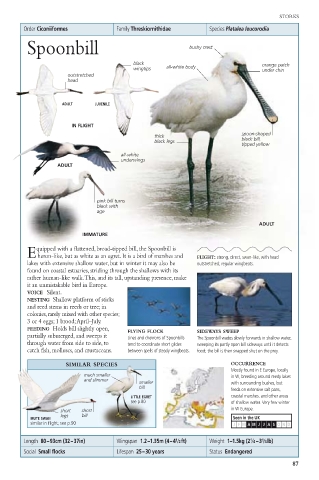
        Spoonbill                               bushy crest


                                  black                           orange patch
                                  wingtips  all-white body        under chin
                  outstretched
                  head

                ADULT    JUVENILE

                   IN FLIGHT
                                                             spoon-shaped
                                       thick
                                       black legs            black bill,
                                                             tipped yellow
                               all-white
                               underwings
               ADULT


                         pink bill turns
                         black with
                         age
                                                                 ADULT
                     IMMATURE
          quipped with a flattened, broad-tipped bill, the Spoonbill is
        E heron-like, but as white as an egret. It is a bird of marshes and  FLIGHT: strong, direct, swan-like, with head
        lakes with extensive shallow water, but in winter it may also be  outstretched; regular wingbeats.
        found on coastal estuaries, striding through the shallows with its
        rather human-like walk.This, and its tall, upstanding presence, make
        it an unmistakable bird in Europe.
        VOICE Silent.
        NESTING Shallow platform of sticks
        and reed stems in reeds or tree; in
        colonies,rarely mixed with other species;
        3 or 4 eggs; 1 brood;April–July.
        FEEDING Holds bill slightly open,  FLYING FLOCK  SIDEWAYS SWEEP
        partially submerged, and sweeps it  Lines and chevrons of Spoonbills  The Spoonbill wades slowly forwards in shallow water,
        through water from side to side, to  tend to coordinate short glides  sweeping its partly open bill sideways until it detects
        catch fish, molluscs, and crustaceans.  between spells of steady wingbeats.  food; the bill is then snapped shut on the prey.
                 SIMILAR SPECIES                          OCCURRENCE
                                                          Mostly found in E Europe, locally
                      much smaller                        in W, breeding around reedy lakes
                      and slimmer
                                    smaller               with surrounding bushes, but
                                    bill
                                                          feeds on extensive salt pans,
                                 LITTLE EGRET             coastal marshes, and other areas
                                 see p.80                 of shallow water. Very few winter
                short  short                              in W Europe.
                legs  bill
         MUTE SWAN                                         Seen in the UK
         similar in flight; see p.90                       J  F  M  A  M  JJ A S O  N  D
       Length  80–93cm (32–37in)  Wingspan  1.2–1.35m (4–4 1 ⁄2ft)  Weight  1–1.5kg (2 1 ⁄4 –3 1 ⁄4lb)
       Social  Small flocks   Lifespan  25–30 years  Status  Endangered
                                                                          87

