


Page 88 - Complete Birds of Britain and Europe (DK - RSPB)
P. 88
STORKS
       Order Ciconiiformes    Family Ciconiidae      Species Ciconia nigra
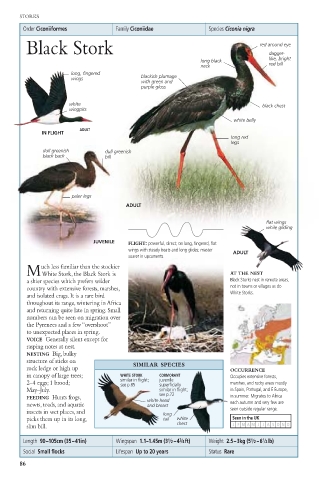
        Black Stork                                               red around eye
                                                                    dagger-
                                                                    like, bright
                                                   long black
                                                   neck             red bill
                   long, fingered
                   wings            blackish plumage
                                    with green and
                                    purple gloss
                  white                                           black chest
                  wingpits
                                                           white belly
                     ADULT
           IN FLIGHT
                                                          long red
                                                          legs
            dull greenish  dull greenish
            black back     bill


                   paler legs
                                ADULT
                                                                   flat wings
                                                                   while gliding
                        JUVENILE  FLIGHT: powerful, direct; on long, fingered, flat
                                 wings with steady beats and long glides; master  ADULT
                                 soarer in upcurrents.
           uch less familiar than the stockier
        MWhite Stork, the Black Stork is                  AT THE NEST
        a shier species which prefers wilder              Black Storks nest in remote areas,
        country with extensive forests, marshes,          not in towns or villages as do
        and isolated crags. It is a rare bird             White Storks.
        throughout its range, wintering in Africa
        and returning quite late in spring. Small
        numbers can be seen on migration over
        the Pyrenees and a few “overshoot”
        to unexpected places in spring.
        VOICE Generally silent except for
        rasping notes at nest.
        NESTING Big, bulky
        structure of sticks on    SIMILAR SPECIES
        rock ledge or high up                             OCCURRENCE
        in canopy of large trees;  WHITE STORK  CORMORANT  Occupies extensive forests,
        2–4 eggs; 1 brood;     similar in flight;  juvenile  marshes, and rocky areas mostly
                                         superficially
                               see p.85
        May–July.                        similar in flight;  in Spain, Portugal, and E Europe,
                                         see p.72
        FEEDING Hunts frogs,          white head          in summer. Migrates to Africa
        newts, toads, and aquatic     and breast          each autumn and very few are
        insects in wet places, and        long            seen outside regular range.
        picks them up in its long,        tail  white      Seen in the UK
        slim bill.                           chest         JF M A  M J  JA S ON D
       Length  90–105cm (35–41in)  Wingspan  1.1–1.45m (3 1 ⁄2 –4 3 ⁄4ft)  Weight  2.5–3kg (5 1 ⁄2 –6 1 ⁄2lb)
       Social  Small flocks   Lifespan  Up to 20 years  Status  Rare
      86 86

