


Page 137 - (DK) Smithsinian - Military History: The Definitive Visual Guide to the Objects of Warfare
P. 137
135

                                                               CAVALRY AND CANNON
                                                               THE BATTLE                                                               THE BA


                                                               OF MOHACS


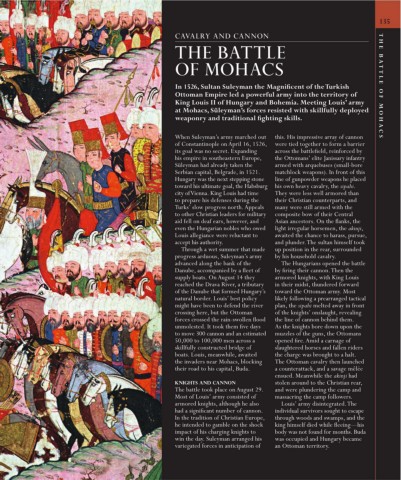
                                                               In 1526, Sultan Suleyman the Magnificent of the Turkish
                                                               Ottoman Empire led a powerful army into the territory of                 TTLE OF MOHA
                                                               King Louis II of Hungary and Bohemia. Meeting Louis’ army
                                                               at Mohacs, Süleyman’s forces resisted with skillfully deployed
                                                               weaponry and traditional fighting skills.


                                                               When Suleyman’s army marched out    this. His impressive array of cannon   CS
                                                               of Constantinople on April 16, 1526,  were tied together to form a barrier
                                                               its goal was no secret. Expanding    across the battlefield, reinforced by
                                                               his empire in southeastern Europe,   the Ottomans’ elite Janissary infantry
                                                               Süleyman had already taken the      armed with arquebuses (small-bore
                                                               Serbian capital, Belgrade, in 1521.   matchlock weapons). In front of this
                                                               Hungary was the next stepping stone   line of gunpowder weapons he placed
                                                               toward his ultimate goal, the Habsburg  his own heavy cavalry, the sipahi.
                                                               city of Vienna. King Louis had time    They were less well armored than
                                                               to prepare his defenses during the   their Christian counterparts, and
                                                               Turks’ slow progress north. Appeals   many were still armed with the
                                                               to other Christian leaders for military   composite bow of their Central
                                                               aid fell on deaf ears, however, and   Asian ancestors. On the flanks, the
                                                               even the Hungarian nobles who owed   light irregular horsemen, the akinji,
                                                               Louis allegiance were reluctant to   awaited the chance to harass, pursue,
                                                               accept his authority.               and plunder. The sultan himself took
                                                                  Through a wet summer that made   up position in the rear, surrounded
                                                               progress arduous, Suleyman’s army   by his household cavalry.
                                                               advanced along the bank of the        The Hungarians opened the battle
                                                               Danube, accompanied by a fleet of   by firing their cannon. Then the
                                                               supply boats. On August 14 they     armored knights, with King Louis
                                                               reached the Drava River, a tributary    in their midst, thundered forward
                                                               of the Danube that formed Hungary’s   toward the Ottoman army. Most
                                                               natural border. Louis’ best policy   likely following a prearranged tactical
                                                               might have been to defend the river   plan, the sipahi melted away in front
                                                               crossing here, but the Ottoman      of the knights’ onslaught, revealing
                                                               forces crossed the rain-swollen flood   the line of cannon behind them.
                                                               unmolested. It took them five days    As the knights bore down upon the
                                                               to move 300 cannon and an estimated   muzzles of the guns, the Ottomans
                                                               50,000 to 100,000 men across a      opened fire. Amid a carnage of
                                                               skillfully constructed bridge of    slaughtered horses and fallen riders
                                                               boats. Louis, meanwhile, awaited    the charge was brought to a halt.
                                                               the invaders near Mohacs, blocking    The Ottoman cavalry then launched
                                                               their road to his capital, Buda.    a counterattack, and a savage mêlée
                                                                                                   ensued. Meanwhile the akinji had
                                                               KNIGHTS AND CANNON                  stolen around to the Christian rear,
                                                               The battle took place on August 29.   and were plundering the camp and
                                                               Most of Louis’ army consisted of    massacring the camp followers.
                                                               armored knights, although he also     Louis’ army disintegrated. The
                                                               had a significant number of cannon.   individual survivors sought to escape
                                                               In the tradition of Christian Europe,   through woods and swamps, and the
                                                               he intended to gamble on the shock   king himself died while fleeing—his
                                                               impact of his charging knights to    body was not found for months. Buda
                                                               win the day. Suleyman arranged his   was occupied and Hungary became
                                                               variegated forces in anticipation of   an Ottoman territory.

