


Page 139 - (DK) Smithsinian - Military History: The Definitive Visual Guide to the Objects of Warfare
P. 139
137
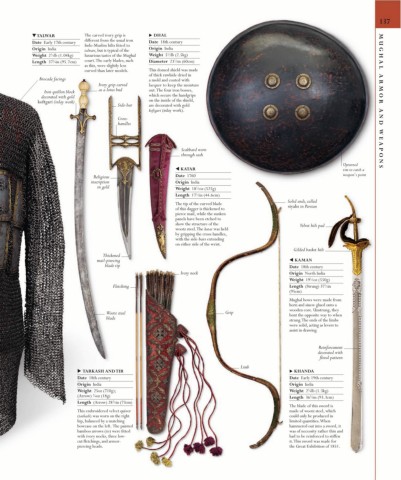
▼ TALWAR The carved ivory grip is ▶ DHAL
different from the usual iron
Date Early 17th century Date 18th century
Indo-Muslim hilts fitted to
Origin India talwars, but is typical of the Origin India
1
1
Weight 2 ⁄4lb (1.04kg) luxurious tastes of the Mughal Weight 5 ⁄2lb (2.5kg)
1
3
Length 37 ⁄4in (95.7cm) court. The early blades, such Diameter 23 ⁄2in (60cm)
as this, were slightly less
curved than later models. This domed shield was made
of thick rawhide dried in
Brocade facings a mold and coated with
Ivory grip carved lacquer to keep the moisture
as a lotus bud out. The four iron bosses,
Iron quillon block
decorated with gold which secure the handgrips
koftgari (inlay work) on the inside of the shield, MUGHAL ARMOR AND WEAPONS
Side-bar are decorated with gold
koftgari (inlay work).
Cross-
handles
Scabbard worn
through sash
Upturned
◀ KATAR rim to catch a
Religious Date 1760 weapon’s point
inscription Origin India
in gold Weight 18 ⁄2oz (525g)
1
1
Length 17 ⁄2in (44.6cm)
Solid ends, called
The tip of the curved blade
of this dagger is thickened to siyahs in Persian
pierce mail, while the sunken
panels have been etched to
show the structure of the Velvet hilt pad
wootz steel. The katar was held
by gripping the cross-handles,
with the side-bars extending
on either side of the wrist.
Gilded basket hilt
Thickened
mail-piercing ◀ KAMAN
blade tip Date 18th century
Ivory nock Origin North India
Weight 19 ⁄2oz (550g)
1
1
Fletching Length (Strung) 37 ⁄2in
(95cm)
Mughal bows were made from
horn and sinew glued onto a
wooden core. Unstrung, they
Wootz steel Grip bent the opposite way to when
blade strung. The ends of the limbs
were solid, acting as levers to
assist in drawing.
Reinforcement
decorated with
floral pattern
Limb
▶ TARKASH AND TIR ▶ KHANDA
Date 18th century Date Early 19th century
Origin India Origin India
3
Weight 25oz (710g); Weight 2 ⁄4lb (1.3kg)
(Arrow) ⁄4oz (18g) Length 36 ⁄4in (93.3cm)
3
3
3
Length (Arrow) 28 ⁄4in (73cm)
The blade of this sword is
This embroidered velvet quiver made of wootz steel, which
(tarkash) was worn on the right could only be produced in
hip, balanced by a matching limited quantities. When
bowcase on the left. The painted hammered out into a sword, it
bamboo arrows (tir) were fitted was of necessity rather thin and
with ivory nocks, three low- had to be reinforced to stiffen
cut fletchings, and armor- it. This sword was made for
piercing heads. the Great Exhibition of 1851.

